Plastic Comb Material Selection: PP vs ABS for Injection Molding
Choosing a plastic comb material should start with the comb design and its manufacturing requirements, not with a generic comparison of resin properties. Tooth length and thickness, required flexibility, body rigidity, surface appearance, dimensional stability, color requirements and molding behavior all influence whether PP, ABS or another resin is appropriate.
At DTG, we consider material selection as part of DFM and mold development because the selected resin affects more than the finished part. It can influence cavity dimensions, shrinkage compensation, filling behavior, cooling, ejection and the processing window. For product designers, the practical question is therefore not simply “Is PP or ABS better?” but “Which material fits this comb geometry, appearance requirement and production objective?”
Start Material Selection with the Comb Design
Different products can all be described as plastic combs while placing very different demands on the resin. A comb with long, fine teeth does not necessarily need the same balance of properties as a wide-tooth comb, compact pocket comb, thick-handled design or two-color product.
Before selecting an injection molding material for a comb, our engineering team normally looks at the product requirements that can affect both part performance and manufacturability:
- Comb type and overall product structure
- Tooth length, thickness, width and spacing
- Required tooth flexibility and body rigidity
- Impact and handling requirements
- Surface finish, texture and appearance expectations
- Color and secondary decoration requirements
- Dimensional stability and tolerance requirements
- Moldability of thin or long features
- Production volume and processing considerations
- Target part cost and end-use environment
Material selection should follow the comb design, not the other way around. This approach helps prevent a resin choice made early in development from creating unnecessary compromises later in tooling or production.
PP Plastic Comb: Engineering Considerations
Polypropylene is commonly considered for injection-molded products where a useful balance of toughness, flexibility, chemical resistance, low density and manufacturing economics is required. For a PP plastic comb, however, those general properties need to be evaluated against the actual tooth and body geometry.
Flexibility and Tooth Geometry
PP can be useful where the design benefits from more compliant teeth rather than a highly rigid structure. That does not mean every PP comb will have flexible teeth. Tooth length, cross-section, width and root geometry strongly affect bending behavior. A short, thick PP tooth can behave very differently from a long, thin tooth made from the same resin.
Shrinkage and Dimensional Control
PP’s molding shrinkage deserves attention when tooth spacing, overall length and body flatness are important. Mold dimensions must account for the selected grade and expected molding behavior, while actual dimensions should be confirmed through trial molding. For a comb containing many regularly spaced teeth, dimensional change can affect the relationship between multiple features rather than only one overall dimension.
Surface and Decoration Requirements
If the product requires printing, coating or another secondary surface operation, the specific PP grade and surface treatment requirements should be reviewed early. Material selection cannot be separated from the intended appearance and decoration process.
ABS Plastic Comb: Engineering Considerations
ABS may be considered when a comb design places greater emphasis on rigidity, dimensional behavior and surface appearance. Its ability to reproduce molded surface details and support appearance-oriented applications can be relevant to products with defined textures, visible branding areas or specific finish requirements.
Rigidity Is Not the Same as “Strength”
It is not useful to describe ABS simply as “stronger” than PP. Material behavior should be separated into engineering properties such as stiffness, toughness, impact behavior and flexibility. A more rigid resin may support a stiff comb body, but tooth geometry still determines whether individual teeth have the required bending behavior.
Fine Teeth Still Require DFM
Selecting ABS does not remove the need to evaluate thin or long teeth. Tooth cross-section, flow distance, gate strategy and venting still affect filling, while the geometry and resin together influence the risk of deformation or breakage during use and ejection.
Appearance and Secondary Finishing
Where surface appearance, molded texture, color or secondary finishing is important, ABS can provide useful options. The exact resin grade and finishing process should nevertheless be confirmed together because not every ABS formulation behaves identically.
PP vs ABS Injection Molding for Plastic Combs
For OEM development, the useful comparison is not PP versus ABS in isolation. It is how each material characteristic affects the finished comb, its mold and its production process. The following table summarizes the main decision areas without assigning universal property values that may vary by resin grade.
| OEM Consideration | PP | ABS | What It Means for Comb Design |
|---|---|---|---|
| Rigidity | Generally more compliant, depending on grade. | Generally offers higher rigidity. | Relevant to handle stiffness, body structure and the required feel of the finished part. |
| Tooth flexibility | Often useful where more flexible tooth behavior is desired. | More rigid behavior requires tooth geometry to be evaluated carefully. | Material and tooth length, thickness, width and root geometry must be considered together. |
| Surface appearance | Suitable for many molded-in color applications; secondary surface processes may require additional consideration. | Often considered for appearance-focused parts and defined surface finishes. | Review gloss, texture, logo and decoration requirements before material approval. |
| Shrinkage | Typically requires greater attention to molding shrinkage and dimensional compensation. | Typically exhibits lower molding shrinkage than PP, although grade-specific data still applies. | Influences cavity dimensions, tooth spacing, overall dimensions and flatness. |
| Moldability | Flow and shrinkage behavior must be matched to the comb geometry. | Flow, drying requirements and process conditions need to be managed for the selected grade. | Thin teeth should be evaluated with gate location, flow length and venting. |
| Secondary operations | Surface characteristics may require additional preparation for some decoration processes. | Often considered where printing or appearance-related finishing is required. | Confirm the actual logo, printing and finishing process during development. |
| Cost evaluation | Material economics can be attractive for suitable designs and production requirements. | Resin cost may differ, but appearance and processing requirements also affect the decision. | Compare total molded-part cost rather than resin price alone. |
Tooth Flexibility Depends on Material and Geometry
One of the most important points in material selection for a plastic comb is that tooth flexibility cannot be predicted from the resin name alone. Material properties establish part of the behavior, but tooth geometry determines how those properties are expressed in the finished component.
Longer or thinner teeth generally behave differently from short or thick teeth made from the same material. Tooth width, spacing and root geometry also influence bending and stress distribution. Abrupt transitions at the tooth root may create local stress concentrations, while geometry changes can alter both flexibility and mold filling.
Material properties + tooth geometry + molding quality determine the final tooth behavior. For this reason, our DFM review treats material selection and product geometry as connected engineering decisions.
Resin Flow Behavior and Thin Comb Teeth
Comb teeth create long, narrow mold cavities. As molten resin travels through these sections, the geometry creates flow resistance and the melt progressively loses heat. Resin flow behavior therefore matters when selecting a material for a design with particularly thin or long teeth.
This does not mean material flow alone determines whether the teeth will fill. Gate position, flow length, mold venting and process conditions also contribute. The important design principle is that comb geometry should be evaluated together with resin flow behavior during material selection.
For a deeper explanation of gate design, venting, short shots, cooling and tooth filling, see our plastic comb injection molding process guide.
Why Shrinkage Matters to Tooth Spacing and Flatness
Shrinkage is especially relevant to comb geometry because the product contains many repeated features whose relative positions matter. Dimensional change can influence not only the overall comb length but also tooth pitch, spacing, body flatness and alignment.
PP and ABS do not have identical shrinkage behavior, and even materials within the same polymer family can vary by grade, formulation and molding conditions. A mold developed around one resin should therefore not automatically be assumed to produce the same final dimensions after a material change.
At DTG, material requirements are considered during design evaluation because shrinkage affects cavity and core dimensions before steel is finalized. Trial molding then provides the molded samples needed to verify the actual dimensional result and determine whether adjustments are required.
Changing the Resin Can Change the Mold Requirements
Changing resin after the mold has been designed is not always a simple material substitution. The new material may have different shrinkage, flow behavior, processing requirements and surface reproduction characteristics. These differences can affect mold dimensions and the way the part fills, cools and releases.
Depending on the project, material selection can influence:
- Shrinkage allowance and cavity dimensions
- Gate and runner strategy
- Venting requirements for difficult-to-fill features
- Cooling and dimensional stability
- Draft, release behavior and ejection
- Surface texture and appearance reproduction
For a custom project, confirming the intended resin before final mold design reduces the risk of discovering material-related dimensional or processing conflicts after tooling has already progressed.
Color, Surface Finish and Branding Requirements
OEM customers often define appearance requirements rather than specifying a polymer first. A project may require a particular molded-in color, gloss level, texture, logo or secondary printing process. These requirements should be discussed during material selection rather than after the mold is complete.
Colorant or masterbatch selection needs to be compatible with the base resin and intended appearance. Surface texture, molded detail and secondary decoration can also respond differently to different materials. When appearance is a key product requirement, the practical selection process should therefore consider the resin, mold surface and finishing method as one system.
Material Selection for a Two-Color Plastic Comb
Two-color designs add another layer to plastic comb material selection. A product using the same base resin in two colors creates different engineering questions from a product combining two different polymers.
With two different materials, designers may need to consider compatibility, interface adhesion, processing conditions, shrinkage differences and potential warpage. Where bonding is required, interface geometry or mechanical interlocking may also become relevant. These factors should be evaluated before tooling because the material combination can influence the two-shot mold structure and process.
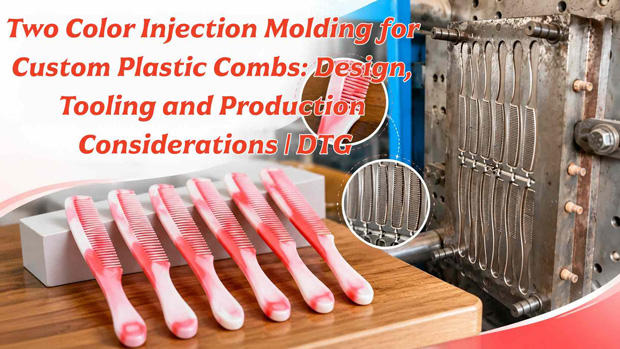
For projects that require two colors or materials within one molded component, our guide to two-color injection molding for custom plastic combs explains the tooling, positioning and second-shot considerations in more detail.
The Lowest Resin Price Does Not Always Mean the Lowest Part Cost
For purchasing teams, resin price is important, but it is only one component of the finished-part economics. A lower price per kilogram does not automatically produce a lower total cost per molded comb.
Material price + part weight + cycle time + scrap + processing requirements + secondary operations + tooling implications = actual part cost
The relevant comparison is therefore the manufacturing system as a whole. A resin that fits the geometry, molding process and appearance requirements can reduce downstream complications that would otherwise offset an apparent raw-material saving.
Validate Plastic Comb Material Selection Through Trial Molding
Datasheets and engineering analysis help narrow the material choice, but an OEM injection-molded part ultimately needs to be evaluated in its molded form. Trial molding connects the selected resin with the actual tool geometry and production process.
During sample evaluation, relevant questions include:
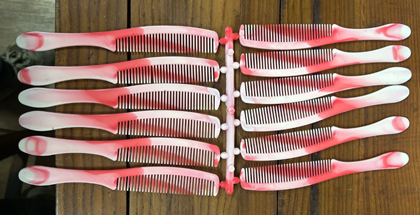
- Are all thin and long teeth completely filled?
- Do the teeth remain straight after molding and ejection?
- Does the body meet the required flatness?
- Is tooth spacing consistent with the drawing requirements?
- Does the surface reproduce the intended appearance?
- Is the molded color acceptable for the project?
- Are short shots, flash, warpage or other molding defects present?
- Does the finished part provide the expected structural behavior?
At DTG, our process includes design evaluation, mold manufacturing, mold testing, sample review and mold modification when required before approved production. This gives the project team an opportunity to verify material-related assumptions on actual molded parts rather than relying only on nominal resin properties.
A Practical Material Selection Checklist for Product Designers
Before finalizing PP, ABS or another resin, it is useful to review the material decision against the complete product specification:
- Define the required flexibility of the teeth and rigidity of the comb body.
- Review tooth geometry for bending behavior and injection moldability.
- Consider resin flow behavior for long or thin tooth cavities.
- Evaluate shrinkage against tooth spacing, flatness and dimensional requirements.
- Confirm color, texture, gloss, logo and secondary finishing requirements.
- Identify whether a single resin or two-material structure is required.
- Evaluate material cost as part of total molded-part cost.
- Validate the final choice through tooling trials and molded sample evaluation.
Choosing Between PP and ABS for an OEM Comb Project
There is no single best plastic for comb manufacturing. PP may be a practical candidate when the design benefits from its particular balance of flexibility, toughness and production economics. ABS may be considered when rigidity, dimensional behavior and appearance requirements carry greater weight. Neither choice should be made independently of tooth geometry, mold design and end-use requirements.
If you are developing a new custom comb, our custom plastic comb manufacturing capability covers the development path from design evaluation and mold creation through trial molding and production. Material selection can be reviewed alongside the actual part geometry before the tooling strategy is finalized.
Discuss Material and Moldability Requirements with DTG
For a new comb project, material selection is most useful when evaluated together with the CAD geometry, appearance specification and expected manufacturing requirements. If you have a 3D model, drawing, physical sample or reference product, our engineering team can review the design and discuss suitable material and molding considerations before tooling.
Discuss Your Plastic Comb Project