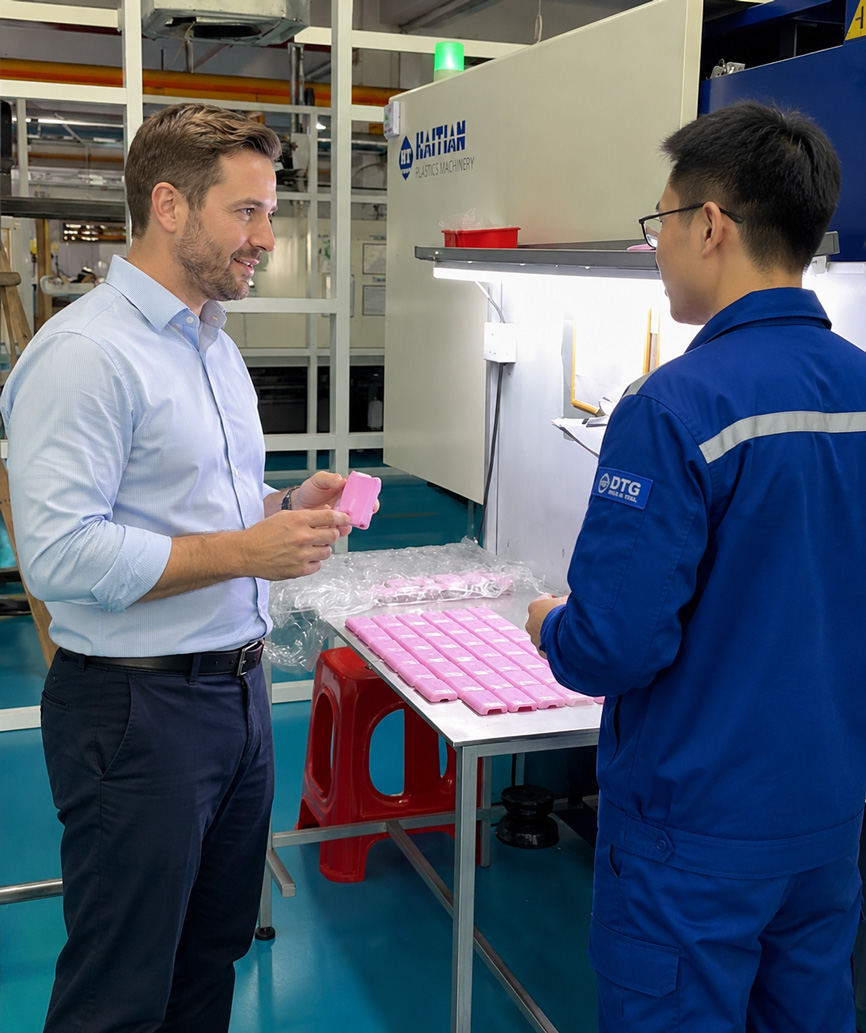
Custom Plastic Comb Manufacturer & Injection Molding
Custom Plastic Comb Manufacturer & Injection Molding
A custom plastic comb project is rarely just a matter of changing the color of a standard part. For OEM and industrial buyers, the actual challenge is maintaining the required tooth geometry, body structure, appearance, dimensional consistency and production stability at the target volume.
DTG TECH CO., LTD. provides custom mold making and injection molding from DFM and tooling development through trial molding, sample approval and repeat production. We evaluate the design around its intended application, material requirements, production volume and manufacturing risks before moving into mass production.
Where Custom Comb Projects Create Manufacturing Risk
Custom combs may be used for personal-care products, professional grooming products, promotional programs, branded accessories, kits and other applications where appearance and repeatability matter. The manufacturing requirements can vary significantly between projects.
- Long or thin teeth can make complete filling more demanding.
- Small changes in tooth spacing or thickness can affect product consistency.
- A flat or elongated body can be sensitive to cooling and shrinkage behavior.
- Demolding forces must be managed to avoid bending or damaging the teeth.
- Color, logo, texture and printing requirements add appearance-control considerations.
- Multi-cavity production requires attention to cavity-to-cavity consistency.
What OEM Buyers Usually Need to Control
The right manufacturing route depends on more than the finished appearance. Geometry, intended use, material, tooling requirements, annual volume and target cost need to be evaluated together.
Custom Plastic Comb Types & OEM Requirements
A custom-molded comb starts with the required geometry, application, material, appearance and production volume. Customers can provide a CAD file, 2D drawing, 3D model, physical sample or reference product for engineering evaluation.
| Customization Area | Typical OEM Requirements | Manufacturing Consideration |
|---|---|---|
| Overall geometry | Straight or curved body, compact or extended format | Parting line, draft, cooling and ejection |
| Comb teeth | Tooth length, thickness, spacing and tip geometry | Filling, venting, cavity precision and demolding |
| Body & handle | Handle features, hanging hole, ribs or reinforcement | Wall transitions, sink risk and structural rigidity |
| Branding | Logo, printing, texture and custom color | Mold finish, gate location and secondary decoration |
| Production | Prototype, trial production and repeat mass production | Cavity count, cycle stability, inspection and mold maintenance |
Comb Teeth & Body Structure
Tooth geometry is one of the most important engineering considerations in an injection-molded comb. Tooth length, thickness, width, spacing, tip geometry and the tooth-to-body transition all influence both product performance and molding behavior.
Longer and thinner teeth can provide greater flexibility, but they can also create more demanding filling, cooling and demolding conditions. For this reason, tooth dimensions should be evaluated together with material selection, draft angle, gate location, venting and ejection.
Rather than applying one universal tooth-size rule, DTG evaluates the actual product geometry, customer drawing, material and intended application before recommending manufacturable dimensions and tolerances.
Geometry Checklist
- Tooth length and thickness
- Tooth spacing and arrangement
- Tooth tip and root geometry
- Tooth-to-body transition
- Body thickness and flatness
- Handle geometry and functional features
- Draft angle and demolding direction
- Tolerances according to actual drawing and process capability
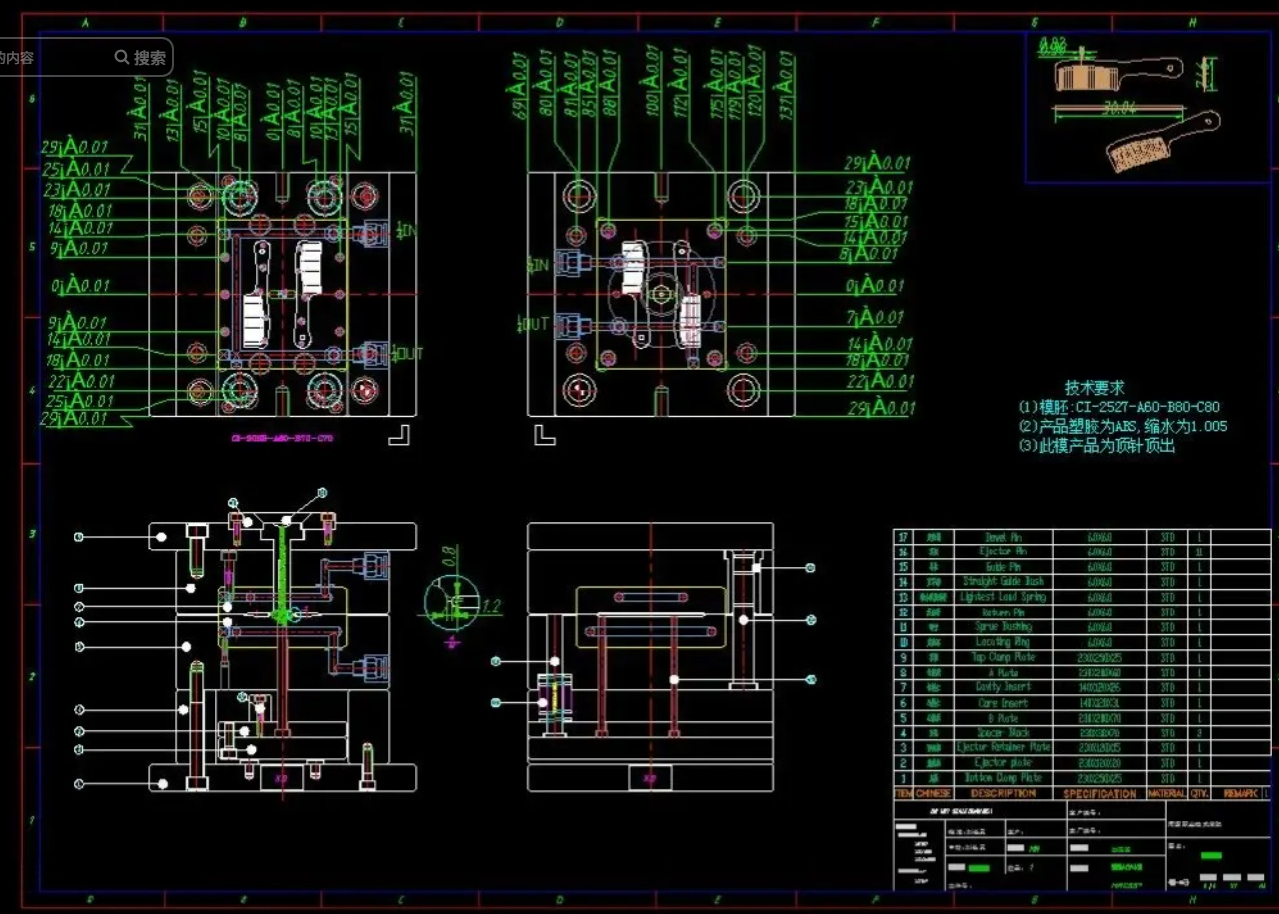
Image placeholder — comb mold cavity / DFM / tooling detail
DFM for Custom Plastic Combs
DFM connects the customer’s comb design with an actual repeatable molding process. Before tooling, the engineering review should determine whether the teeth can fill completely, whether wall transitions are reasonable, whether draft is sufficient and whether the part can be ejected without damaging the teeth.
- Complete filling of narrow tooth cavities
- Wall thickness and transition review
- Draft and demolding direction
- Parting line and gate location
- Venting at end-of-fill areas
- Potential warpage and shrinkage behavior
- Realistic tolerances for the selected material and process
Material Selection: PP, ABS and Other Options
There is no single best plastic for every custom comb. Material selection should be based on comb geometry, tooth requirements, appearance, manufacturing requirements, target cost and any application-specific environmental or chemical requirements.
| Material Factor | PP | ABS | Other Engineering Options |
|---|---|---|---|
| Rigidity / flexibility | Often suitable where flexibility is beneficial | Generally provides a more rigid molded feel | Depends on selected grade and design |
| Surface / appearance | Good color and molded-surface options | Good appearance and finishing potential | Grade-specific |
| Shrinkage / dimensional behavior | Requires project-specific shrinkage consideration | Requires project-specific process and tooling evaluation | Confirm grade data before tooling |
| Selection basis | Geometry + flexibility + cost + application | Rigidity + appearance + impact requirements | Customer specification and application requirements |
For a deeper PP vs. ABS comparison and material-selection discussion, see Plastic Comb Materials: PP, ABS and Material Selection.
Comb Mold Design & Tooth Cavity Precision
Comb mold design must handle dozens of narrow tooth features together with the larger body section. Cavity/core geometry, parting line, gate, runner, venting, cooling and ejection therefore need to be considered as one tooling system.
Tooling precision is especially important around tooth thickness, tooth spacing, straightness and repeatability. Actual tolerances should be established from the product drawing, feature size, material, mold design and expected process capability rather than applying an arbitrary universal tolerance.
Mold Manufacturing & Tooth Cavity Precision
Depending on the tooling design, mold manufacturing may involve CNC machining, EDM, wire EDM where applicable, grinding, polishing, insert manufacturing, mold fitting and dimensional inspection.
For comb tooling, cavity/core alignment and the repeatability of narrow tooth features are particularly important. The objective is not simply to machine a cavity that produces one acceptable sample, but to establish tooling capable of producing consistent parts over the intended production life.
- CNC machining of mold components
- EDM and wire EDM where appropriate
- Precision fitting and alignment
- Cavity and core dimensional inspection
- Surface finish and texture according to specification
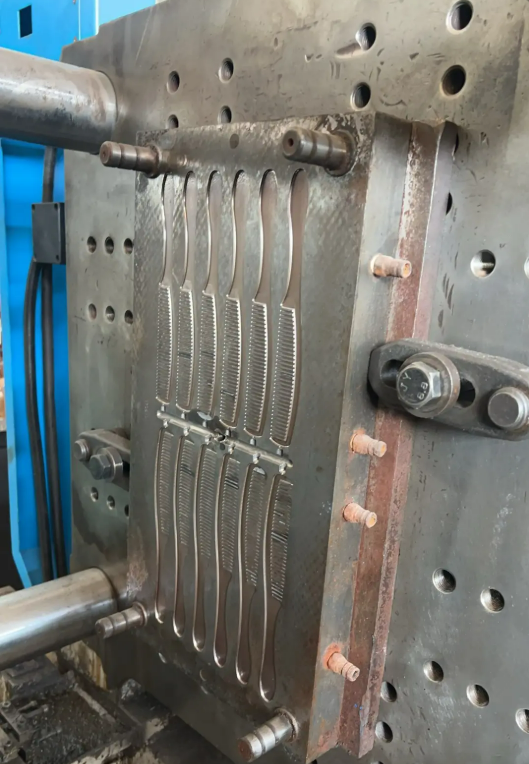
Image placeholder — mold insert, tooth cavity and tooling inspection
Gate, Runner & Venting Design
Gate and runner design determine how molten plastic enters and distributes through the mold. Venting provides an escape path for air, particularly around end-of-fill areas and narrow tooth cavities. The engineering question is straightforward: can molten plastic reach every tooth cavity consistently without creating avoidable filling or appearance problems?
| Area | Engineering Focus | Potential Production Impact |
|---|---|---|
| Gate | Melt entry location and filling direction | Fill balance, gate mark and appearance |
| Runner | Melt distribution and pressure loss | Multi-cavity balance and material efficiency |
| Venting | Air evacuation at difficult fill locations | Short shot, burn marks and inconsistent filling risk |
For a deeper process discussion, see Plastic Comb Injection Molding.
Injection Molding Process for Custom Plastic Combs
Injection molding parameters are not fixed across all projects. Material grade, part geometry, mold design, machine capability and production conditions determine the appropriate process window. DTG focuses on controlling the process rather than applying generic temperature, pressure or cycle-time values to every project.
Comb Teeth Molding — A Key Manufacturing Challenge
Narrow and elongated teeth can create longer flow paths and more demanding filling conditions. Mold precision, gate and runner design, venting and cooling all contribute to tooth consistency.
The manufacturing sequence is interconnected: thin or long teeth can make filling more demanding; venting supports complete filling; cooling affects straightness and shrinkage; and ejection must avoid deformation. Inspection then verifies the final tooth geometry.
Cooling, Shrinkage & Warpage Control
A part can appear fully filled and still fail dimensional or shape requirements. Cooling-channel layout, cooling uniformity, material shrinkage and cycle stability can influence body flatness and tooth straightness.
Longer or flatter comb bodies deserve particular attention because uneven cooling and shrinkage can create warpage that becomes visible only after the part has cooled and stabilized.
Ejection Without Damaging Comb Teeth
A comb can fill correctly and still be damaged during demolding. Draft, ejection location, ejector-system design, mold-release resistance and part temperature all affect the risk of tooth bending, deformation or stress marks.
Mold design therefore needs to answer two questions: how will the part fill, and how will the molded part be released without compromising its critical features?
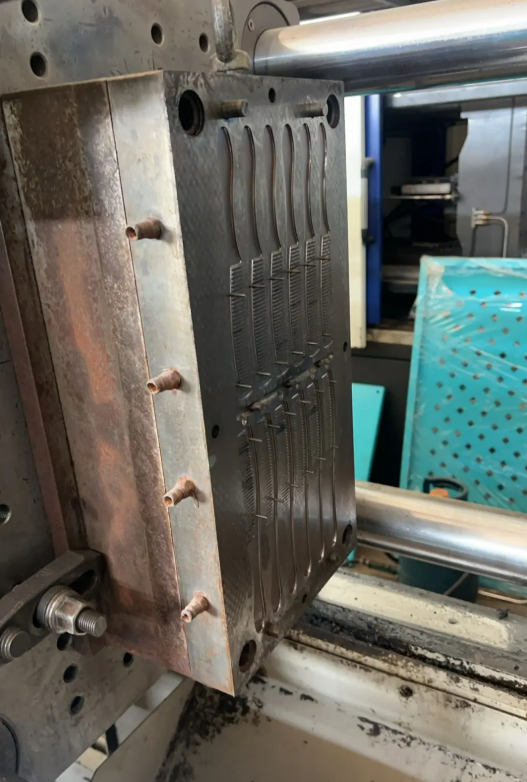
Image placeholder — custom color, logo, texture or two-color comb
Custom Color, Logo, Texture & Branding
OEM projects may require molded-in color, a customer-specific color target, molded logos, recessed or raised branding, surface texture or secondary printing. The appropriate approach depends on the material, mold design, appearance requirements and production volume.
For projects requiring custom-printed plastic comb binding or custom-branded plastic combs, decoration requirements should be reviewed together with the molded part design.
Single-Color vs. Two-Color Comb Manufacturing
Single-color molding is often the simpler route for projects where appearance is achieved through one molded material and secondary branding. A two-color plastic comb can be considered when visual differentiation, a functional second material or a more integrated brand design justifies additional tooling and process complexity.
| Consideration | Single-Color Molding | Two-Color / Two-Shot Approach |
|---|---|---|
| Visual differentiation | One molded color with optional secondary decoration | Integrated second color or material zone |
| Tooling complexity | Generally lower | Higher tooling and process requirements |
| Typical decision basis | Cost, simplicity and appearance | Branding, functional differentiation or design intent |
See Two-Color Injection Molding for Custom Plastic Combs for a deeper discussion of two-color tooling and process considerations.
Prototype, Trial Mold & Sample Approval
The purpose of trial molding is not simply to produce a sample. It is an engineering checkpoint between the customer’s design and repeatable production. Issues identified during this stage can be addressed before the project moves into larger production quantities.
Quality Control for Injection-Molded Combs
Quality control should focus on the features that matter to the actual product specification. For comb projects, this includes both dimensional characteristics and visible molding defects.
Measurement methods, inspection frequency and sampling plans should be defined according to the customer’s drawings, quality requirements, production volume and project risk.
| Inspection Category | Examples |
|---|---|
| Dimensions | Overall size, tooth length, thickness and spacing |
| Geometry | Tooth straightness, body flatness and deformation |
| Molding defects | Short shot, flash, sink, flow marks and burn marks |
| Appearance | Color consistency, surface defects and gate marks |
| Branding | Logo, printing and two-color alignment where applicable |
Common Manufacturing Problems & Preventive Engineering
Production defects should not be treated only as machine-setting problems. Many issues can be reduced earlier through DFM, tooling design, material selection, trial molding and process control.
| Potential Issue | Where It Should Be Considered | Manufacturing Objective |
|---|---|---|
| Incomplete teeth / short shot | DFM, gate, runner, venting and process validation | Consistent filling of narrow tooth cavities |
| Flash | Parting line, tooling fit and process control | Controlled mold shutoff and appearance |
| Warped body | Material, cooling, wall design and process stability | Dimensional stability and flatness |
| Bent or deformed teeth | Draft, ejection and cooling conditions | Release without mechanical deformation |
| Color variation | Material, color specification and process control | Consistent appearance between production batches |
| Two-color misalignment | Tooling, process sequence and registration | Consistent alignment of the two molded regions |
From Prototype to Repeatable Mass Production
For an OEM buyer, the real question is not whether a supplier can make one good sample. It is whether the same part can be produced consistently across repeated molding cycles and production batches.
Related Engineering Resources
Custom Plastic Comb Manufacturing FAQ
What information is needed to quote a custom plastic comb?
A CAD file, 2D drawing, 3D model, physical sample or reference product can be used as the starting point. Production quantity, material preference, appearance requirements and application information are also useful for tooling and process evaluation.
Can DTG manufacture custom plastic binding combs?
Yes. Custom plastic binding combs and other customized plastic combs can be evaluated according to the required geometry, material, branding, tooling and production volume.
Can the comb include a custom logo or color?
Custom color, molded logos, texture and secondary printing can be considered according to the material and product design. Two-color molding is also an option for projects where the additional tooling and process complexity are justified.
What makes an OEM plastic comb manufacturer different from a standard supplier?
An OEM-focused supplier should be able to connect product geometry, DFM, mold design, material selection, trial molding, inspection and repeat production into one controlled manufacturing workflow rather than treating injection molding as a standalone operation.
How does DTG approach customized plastic combs for mass production?
The project is reviewed from DFM through mold development, trial molding, sample approval and production. Critical features such as tooth geometry, body flatness, appearance, material consistency and dimensional repeatability are considered according to the project specification.
Ready To Start Your Project?
Tell us about your part, material, quantity, or mold requirements. Our team will review your project and provide a practical manufacturing solution.