PET vs PETG for Cosmetic Packaging: Key Differences and Material Selection Guide
Choosing between PET vs PETG for cosmetic packaging involves more than comparing transparency and resin prices. Both materials can produce clear, attractive containers, but their differences in toughness, crystallization behavior, molding requirements, and chemical compatibility can significantly influence product performance and manufacturing cost.
For purchasing managers and product development teams, the right material depends on the container’s geometry, intended contents, operating environment, production volume, and quality requirements.
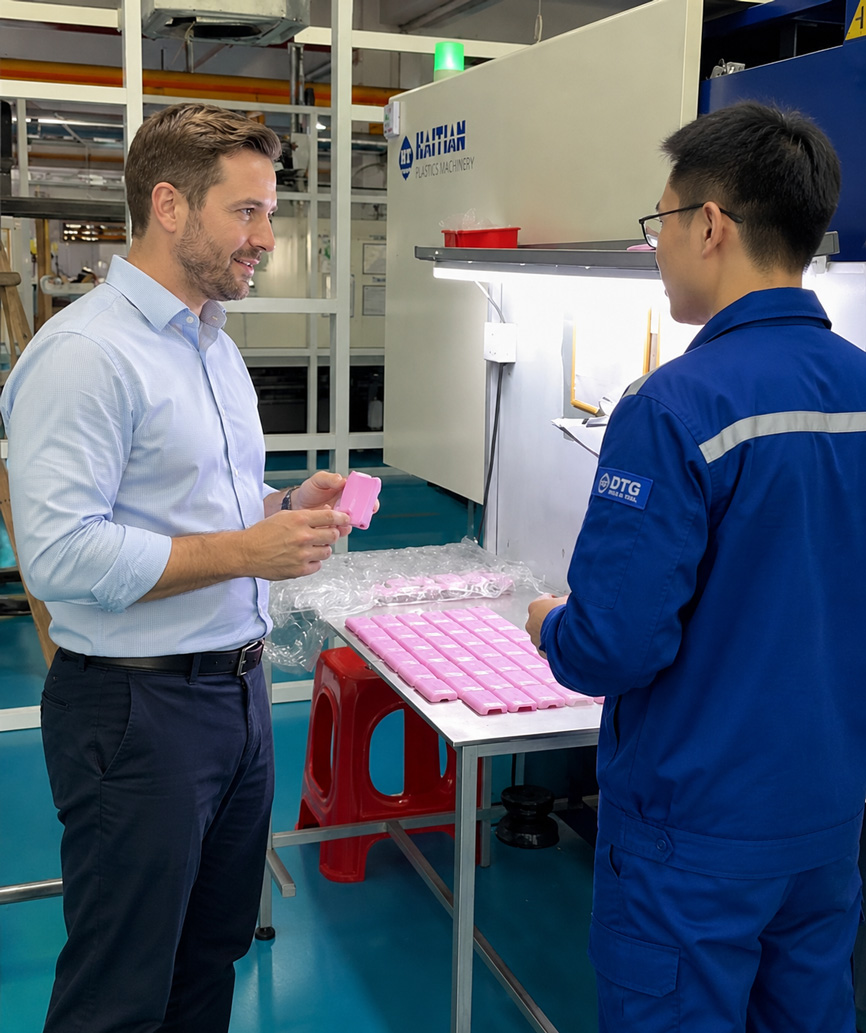
At DTG TECH CO., LTD., we provide mold design, prototyping, injection molding, and production support for custom plastic components. From a manufacturing perspective, we recommend evaluating material selection alongside product design and moldability rather than treating it as a separate purchasing decision.
1. Why Material Selection Matters for Cosmetic Packaging
Cosmetic packaging must satisfy several requirements simultaneously. A clear jar needs an attractive surface finish, sufficient mechanical strength, reliable closure performance, and compatibility with the product it contains.
Material selection influences three important aspects of packaging development:
- Appearance: Transparency, surface gloss, color consistency, and resistance to visible whitening or haze.
- Functionality: Impact resistance, dimensional stability, closure fit, and resistance to cracking during handling.
- Manufacturability: Mold design, processing conditions, cooling requirements, cycle time, and production consistency.
For example, a thin-wall cosmetic container with a simple cylindrical geometry may have different material requirements from a thick-wall display jar with curved surfaces and an integrated snap-fit lid.
Even when both products require high transparency, the most suitable resin may differ.
At DTG, our design evaluation process considers production feasibility before mold manufacturing begins. Reviewing wall thickness, part geometry, material behavior, and expected production quantities early can help reduce the risk of costly design changes after tooling.
2. What Is PET?
PET, or polyethylene terephthalate, is a thermoplastic polyester widely used in bottles, transparent packaging, films, and industrial plastic products.
PET is a semi-crystalline polymer. Depending on its grade, processing method, and cooling history, it can develop different levels of crystallinity that influence its optical and mechanical properties.
Key Characteristics of PET
- High transparency when processed to maintain a predominantly amorphous structure.
- Good stiffness and dimensional performance for many packaging applications.
- Useful barrier properties for selected packaging applications.
- Established resin supply chains and relatively mature recycling infrastructure.
- Generally competitive material pricing compared with specialty PETG grades.
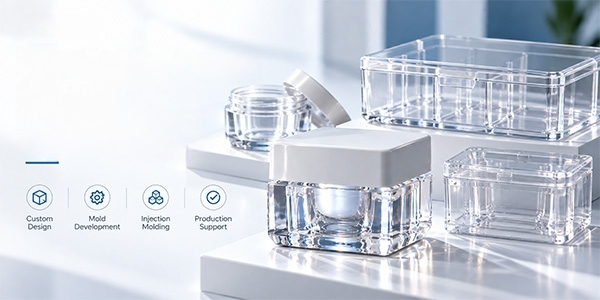
PET cosmetic packaging is often considered for clear jars, lightweight containers, organizer boxes, and other products where appearance and material efficiency are important.
Why PET Processing Requires Careful Control
Although PET can produce highly transparent molded parts, maintaining optical clarity requires suitable processing conditions.
During injection molding, excessive crystallization can create visible haze or whitening, particularly in thicker sections or areas where cooling is uneven.
Gate regions, ribs, corners, and local wall-thickness transitions deserve particular attention because they may cool differently from surrounding surfaces.
Moisture control is another important consideration. PET is sensitive to hydrolytic degradation during melt processing if the resin contains excessive moisture. Appropriate drying should therefore follow the selected material supplier’s recommendations.
For transparent PET parts, the combination of resin grade, mold cooling, gate design, and processing conditions is often more important than any single machine setting.
3. What Is PETG?
PETG is a glycol-modified copolyester related to PET. Its modified molecular structure reduces the tendency to crystallize during conventional processing, allowing many PETG grades to remain highly transparent even in relatively thick sections.
This difference makes PETG particularly relevant to cosmetic containers where visual appearance, impact resistance, and complex geometry are important.
Key Characteristics of PETG
- High optical clarity and a glossy surface appearance.
- Good impact toughness in many commercially available grades.
- Reduced crystallization-related haze during conventional molding.
- Useful processing characteristics for selected complex shapes and thicker sections.
- Availability of grades suitable for thermoforming, injection molding, and other manufacturing methods.
PETG cosmetic containers are commonly considered when a product requires substantial transparent walls, rounded shapes, or greater resistance to impact during handling.
However, PETG should not automatically be regarded as superior in every application. Its heat resistance, chemical resistance, and mechanical performance depend on the specific grade and operating conditions.
In particular, certain alcohol-containing products and cleaning agents can cause environmental stress cracking in stressed PETG components. Actual formulation compatibility must be verified before production approval.
4. PET vs PETG: Side-by-Side Material Comparison
The following comparison summarizes the general differences purchasing and engineering teams should consider when evaluating clear plastic packaging materials.
| Property | PET | PETG |
|---|---|---|
| Polymer structure | Semi-crystalline polyester | Typically amorphous glycol-modified copolyester |
| Transparency | Excellent with suitable grade and processing | Excellent; often advantageous in thick sections |
| Impact toughness | Good in suitable grades; performance depends on orientation and processing | Often higher toughness in comparable rigid molded applications |
| Stiffness | Generally good rigidity | Good rigidity with greater ductility in many grades |
| Injection molding | Requires attention to drying, crystallization, and cooling | Reduced crystallization concerns; drying and process control remain necessary |
| Thick-wall clarity | Greater risk of crystallization-related haze | Often easier to maintain optical clarity |
| Chemical resistance | Formulation-dependent; requires testing | Formulation-dependent; some solvents can cause stress cracking |
| Heat resistance | Depends strongly on grade, crystallinity, and orientation | Typically limited for elevated-temperature applications |
| Material cost | Generally lower resin cost | Generally higher resin cost |
| Recycling infrastructure | More established in many markets | More limited acceptance; requires local verification |
Engineering note: These are general material tendencies, not guaranteed specifications. Optical transmission, impact strength, heat resistance, and chemical performance vary with resin grade, specimen geometry, manufacturing method, and test conditions. Final decisions should use supplier technical data and application-specific testing.
Transparency and Appearance
Both PET and PETG can deliver high transparency. PETG has a practical advantage in many thick-wall injection molded designs because its amorphous structure reduces the risk of crystallization-related cloudiness.
However, transparency is not determined by resin selection alone. Surface finish, mold polishing, gate placement, processing stability, and internal stress can all affect the appearance of finished containers.
Mechanical Performance and Durability
PETG is often selected for applications requiring greater toughness, particularly where containers may experience accidental drops or localized impacts.
PET remains suitable for many rigid packaging applications, especially when the design uses appropriate wall thickness, radii, and reinforcement features.
For snap-fit features, closure retention force and repeated assembly performance should be evaluated using actual molded samples rather than relying only on general material comparisons.
Material Cost and Supply Considerations
PET typically offers a material-cost advantage because of its established production and supply infrastructure. PETG may justify its higher resin price when it reduces design constraints or helps achieve the required appearance and durability.
For purchasing decisions, the relevant comparison is total manufactured part cost, including tooling, cycle time, scrap, inspection, packaging, and expected production volume.
5. How Material Selection Affects Injection Mold Design
For injection molded cosmetic packaging, material choice directly affects the mold design strategy.
At DTG, our mold design and injection molding services cover design evaluation, mold manufacturing, trial samples, and production. For transparent plastic components, we consider several manufacturing factors that influence appearance and repeatability.
Gate Design and Visible Defects
Gate design affects melt flow, local heat concentration, and the appearance of the finished part. For PET, inadequate cooling around the gate may contribute to whitening or haze. Poor gate geometry or processing conditions can also produce stringing, flow marks, and other visible defects.
Depending on the part geometry, side gates, hot-runner systems, or other gate configurations may be considered. The objective is to achieve stable filling while minimizing visible gate marks and avoiding unnecessary thermal stress.
For transparent containers, gate location should be reviewed during design for manufacturability (DFM), particularly when the product has highly visible exterior surfaces.
Cooling and Crystallization Control
PET cooling performance is especially important because its crystallization behavior can influence clarity. Uneven heat removal may create localized cloudy regions, dimensional variation, or residual stress.
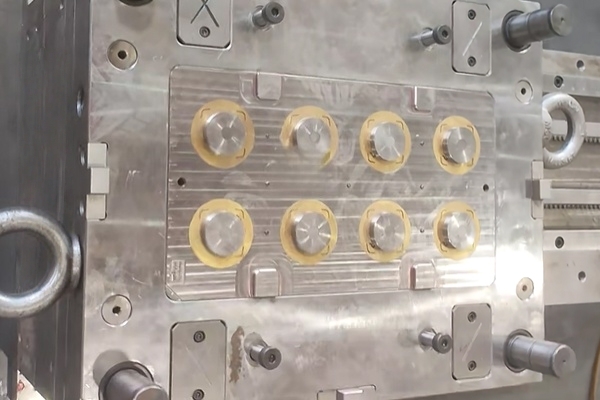
Cooling-channel placement, coolant flow, actual cavity-surface temperature, and wall thickness should be evaluated together.
Excessively aggressive cooling is not automatically beneficial. Cooling conditions must balance optical requirements, residual stress, demolding behavior, and dimensional stability.
For PETG, cooling uniformity remains important for controlling shrinkage, warpage, and cycle time, even though crystallization-related haze is generally less of a concern.
Drying, Venting, and Surface Quality
Both PET and PETG require appropriate moisture control before melt processing. Insufficient drying can contribute to polymer degradation, surface defects, and reduced mechanical performance.
Venting is also important. Trapped gas can lead to burns, incomplete filling, or surface imperfections. For clear packaging, even relatively small defects may be visually unacceptable.
When chilled molds operate in humid environments, condensation can introduce additional surface-quality problems. This is why actual mold temperature and the surrounding production environment should be considered together.
For further insight into tooling evaluation and production planning, see our guide to PET mold development and mass production.
6. Which Material Should You Choose for Cosmetic Jars and Organizer Boxes?
Different packaging structures place different demands on the material. The following selection guide provides a practical starting point for early supplier discussions.
| Application | Initial Material Preference | Main Evaluation Point |
|---|---|---|
| Thin-wall clear cosmetic jars | PET or PETG | Clarity, stiffness, molding cost |
| Thick-wall transparent containers | Consider PETG | Optical clarity through thick sections |
| Clear organizer boxes | PET or PETG | Wall thickness, impact resistance, dimensional consistency |
| Containers with snap-fit features | Evaluate tougher grades, including PETG | Retention force, stress cracking, repeated assembly |
| High-volume standardized packaging | Consider PET first | Resin cost, process efficiency, supply stability |
| Containers contacting cosmetic formulations | Application-specific selection | Chemical compatibility and packaging stability |
Clear Cosmetic Jars
For simple cosmetic jars with relatively uniform walls, PET may provide a suitable combination of transparency, rigidity, and material economy.
For thicker walls, rounded corners, or more demanding impact requirements, PETG may offer greater design flexibility.
However, cosmetic formulations may contain oils, fragrances, alcohols, surfactants, and other ingredients that interact differently with plastic materials. Neither resin should be approved for direct product contact without appropriate compatibility evaluation.
Clear Organizer Boxes
Organizer boxes often require larger flat surfaces, internal compartments, and accurately fitting lids. These features introduce additional concerns about warpage, shrinkage, and assembly consistency.
PET can be an appropriate option for relatively simple designs, while PETG may be worth considering when improved impact toughness or more complex transparent geometry is required.
At DTG, we support the development of custom plastic parts from design evaluation through molding. Our custom PET cosmetic packaging and clear organizer boxes page provides additional context for this product category.
Lids, Snap-Fits, and Assembly Features
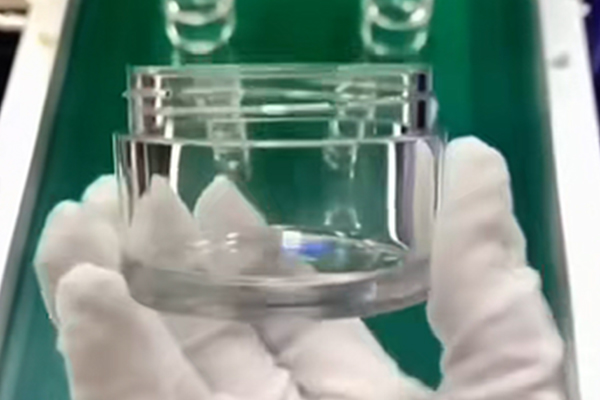
For packaging with mechanical closures, the container body and lid should be evaluated as an assembly rather than as independent parts.
Key considerations include:
- Dimensional tolerances at mating surfaces.
- Snap-fit deflection and retention force.
- Stress concentration around corners and locking features.
- Repeated opening and closing performance.
- Sealing reliability when the packaging requires a controlled closure.
Greater toughness alone does not guarantee reliable snap-fit performance. Geometry, material grade, molding conditions, and the number of expected assembly cycles all matter.
7. How to Validate PET or PETG Before Production
For purchasing managers, a material recommendation becomes meaningful only when it is supported by an achievable manufacturing plan and clearly defined acceptance criteria.
We recommend a structured evaluation before committing to production tooling.
Step 1: Define the Product Requirements
Prepare a specification that identifies the intended application, dimensions, wall thickness, appearance requirements, closure design, expected production volume, and operating conditions.
For cosmetic containers, include information about the product formulation, filling conditions, storage temperature, and expected shelf life where applicable.
Step 2: Review Material Technical Data
Request technical data sheets for the specific PET and PETG grades under consideration. Compare properties measured under equivalent test methods and conditions.
Useful information includes tensile properties, impact performance, heat deflection behavior, recommended processing conditions, and relevant chemical compatibility guidance.
Also confirm grade availability, approved colorants or additives, traceability expectations, and the consistency of future resin supply.
Step 3: Conduct DFM and Moldability Evaluation
At DTG, our engineering and mold design services help translate product requirements into manufacturable plastic components.
During design evaluation, important considerations include wall thickness transitions, draft angles, gate placement, cooling access, shrinkage allowances, and potential assembly problems.
Early DFM review can identify areas where the selected material may require changes to the product geometry or tooling concept.
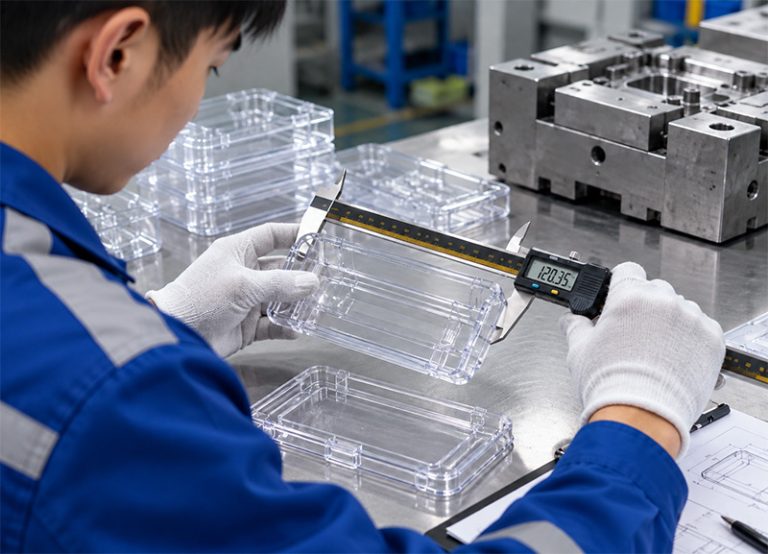
Step 4: Produce and Evaluate Samples
Our development process includes prototyping, mold trials, sample review, and mold adjustments based on feedback before production release.
For transparent packaging, sample evaluation should consider both appearance and functional performance.
| Evaluation Area | What to Check | Why It Matters |
|---|---|---|
| Visual quality | Haze, whitening, bubbles, flow marks, color consistency | Appearance acceptance |
| Dimensional accuracy | Critical dimensions, flatness, warpage | Assembly consistency |
| Mechanical performance | Impact, cracking, closure durability | Handling and service reliability |
| Chemical compatibility | Actual cosmetic formulation exposure | Resistance to swelling, cracking, and appearance changes |
| Production repeatability | Variation across trial parts and molding conditions | Stable production planning |
For formulation-contact packaging, compatibility and shelf-life testing should be defined by the product owner or qualified testing organization. Material data alone cannot establish the suitability of a finished cosmetic packaging system.
Step 5: Review Supplier Readiness and Total Cost
Before issuing a production purchase order, buyers should confirm the mold development schedule, sample approval process, inspection requirements, expected production quantities, and delivery arrangements.
Supplier evaluation should also cover documented quality-management arrangements, material traceability, change control, and how nonconforming parts will be handled.
At DTG, our project workflow includes quotation discussions, design evaluation, mold processing updates, trial samples, customer feedback, and delivery coordination. These steps provide opportunities to align technical expectations before full production.
8. Frequently Asked Questions
Is PET or PETG more suitable for clear cosmetic containers?
Both can be suitable. PET is often attractive for standardized packaging where material economy and established supply chains are priorities. PETG may be preferable for thicker transparent sections or applications requiring additional toughness. Final selection depends on the product design, resin grade, cosmetic formulation, and validated performance requirements.
What is the main difference between PET and PETG?
The main difference is their molecular structure and crystallization behavior. PET is a semi-crystalline polyester, while PETG is modified to suppress crystallization under typical processing conditions. This affects optical clarity in thick sections, processing behavior, and certain mechanical characteristics.
Can PET and PETG both be used for cosmetic packaging?
Yes. Both materials are used in packaging applications, but suitability for a particular cosmetic formulation must be confirmed. Direct-contact applications require evaluation of chemical compatibility, applicable regulatory obligations, and the finished packaging system.
Which factors affect PET and PETG packaging costs?
Major factors include resin grade, raw material pricing, part weight, wall thickness, mold complexity, number of cavities, cycle time, production quantity, scrap rate, and inspection requirements. A higher resin price does not necessarily mean the same percentage increase in total part cost.
Is PETG easier to injection mold than PET?
PETG can simplify certain transparent-part applications because it has less tendency to develop crystallization-related haze. However, both materials require suitable drying, temperature control, mold design, and processing conditions. The relative manufacturing difficulty depends on the specific part and material grade.
Can PETG be recycled through the same system as PET?
Not necessarily. Although both are polyesters, PETG may be incompatible with some conventional PET recycling streams. Collection and sorting acceptance vary by region and recycling operator. Buyers should verify local requirements before making recyclability claims.
9. Final Material Selection Recommendations
For most cosmetic packaging projects, the decision between PET and PETG should begin with the product’s functional requirements rather than a general assumption that one material is universally superior.
Consider PET when the design is relatively straightforward, high transparency can be achieved with appropriate processing, and material economy or established supply infrastructure is important.
Consider PETG when the container has thicker transparent sections, more complex geometry, or greater impact-toughness requirements, provided its chemical and thermal performance meets the application.
For either material, successful production depends on the interaction between resin grade, part design, mold construction, process control, and quality acceptance criteria.
Purchasing teams evaluating custom containers can also review our guide to customizing clear PET cosmetic jars and organizer boxes for additional product-development considerations.
Discuss Your Cosmetic Packaging Material and Mold Design
If you are evaluating PET or PETG for a custom cosmetic jar, transparent container, or organizer box, DTG can support the discussion from material-related design considerations through mold development and injection molding.
Share your 2D drawings, 3D models, expected production volume, appearance requirements, and intended operating conditions. Our engineering team can review manufacturability considerations and discuss an appropriate tooling and production approach.
Contact DTG for Material and DFM Support