How Plastic Chair Molds
Reduce Production Costs
For OEMs, furniture brands, and industrial buyers, plastic
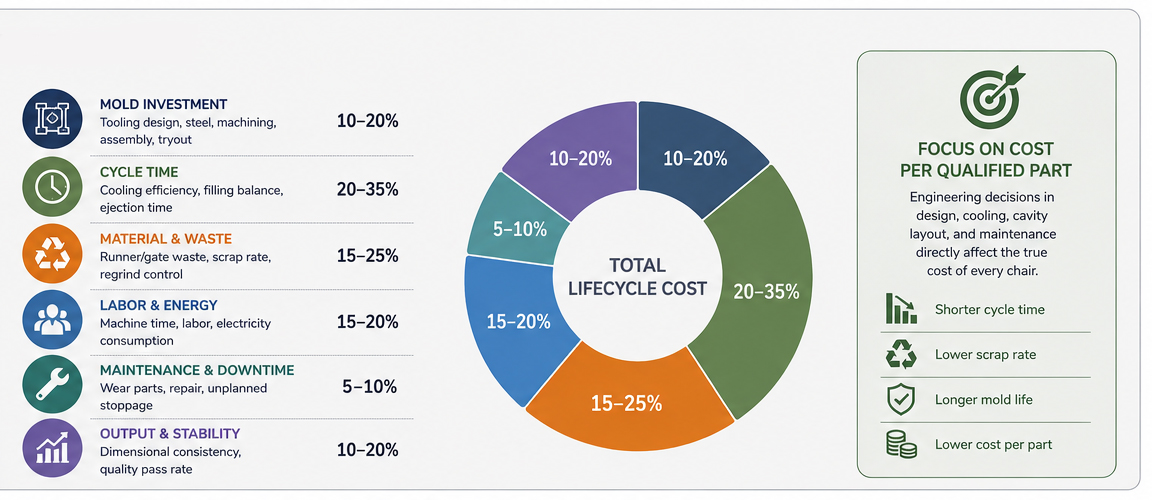
chair molds are no longer evaluated only by the initial tooling price. The more important question is how the
mold controls total production cost across its lifecycle, including cycle time, scrap rate, maintenance, output
stability, and cost per acceptable part.
A chair injection mold may look like a one-time capital purchase, but every design
choice affects long-term molding economics. Wall thickness, cooling layout, cavity number, steel selection,
runner design, and supplier capability all influence whether the project delivers stable production or repeated
cost leakage.
This article explains how engineering-focused mold decisions help reduce molding costs
for plastic chair production, especially for high-volume programs where even a small unit-cost difference can
become significant over hundreds of thousands or millions of parts.
Why Mold Cost Is More Than the Tooling Price
For readers evaluating mold structure, machine tonnage, and one-piece chair feasibility, DTG’s plastic chair injection mold manufacturing page provides a more detailed overview of chair mold capabilities, machine range, shot weight, and DFM support.
Procurement teams often compare quotations by the mold price alone. That
approach can miss the larger cost structure. In chair production, the real cost includes mold
manufacturing, trial runs, modification time, molding cycle time, resin waste, labor, energy,
maintenance, and the final number of qualified parts produced before the mold reaches end of life.
A lower initial quotation may become more expensive if it results in unstable molding,
difficult demolding, excessive flash, short mold life, or frequent production stoppages. A better
purchasing decision considers lifecycle cost rather than only upfront investment.
How Mold Design Controls Long-Term Production Cost
Cost Leverage in the Design Stage
The design stage may represent a small part of the mold budget, but it determines most
downstream cost. A chair mold that is only “acceptable” in structure can require more machining, more trial
corrections, longer cycle time, and higher maintenance effort than a mold designed with production efficiency in
mind.
For large chair parts, common cost drivers include uneven wall thickness, oversized
ribs, insufficient draft angle, unnecessary side actions, and non-standard mold components. These issues
increase the risk of sink marks, warpage, sticking, ejection damage, and longer mold fitting time.
The Value of Early DFM
Early DFM review allows mold engineers to check product structure before steel cutting
begins. CAD and CAE review can identify demolding interference, sharp wall transitions, weld lines in
load-bearing areas, cooling difficulty, and surface requirements that may be over-specified for non-visible
areas.
For example, a non-appearance surface may not require a polished finish if a machined
surface can meet assembly requirements. Avoiding unnecessary polishing on large non-visible chair areas can save
machining hours without affecting functional performance.
Wall Thickness, Ribs, Draft Angles, and Slides
| Design Area | Optimization Method | Production Cost Impact |
|---|---|---|
| Wall thickness | Avoid local heavy sections and control wall transitions | Reduces sink marks, warpage, and scrap rate |
| Rib design | Keep rib thickness around 50–60% of the main wall | Improves stiffness without unnecessary weight |
| Draft angle | Apply suitable draft for PP, PE, or modified resin | Reduces ejection resistance and surface damage |
| Undercuts and slides | Use parting-line design to simplify lifters or slides where possible |
Lowers tooling complexity and maintenance risk |
| Mold base standardization | Use DME, HASCO, or other recognized standard components | Shortens lead time and simplifies future replacement |
For buyers preparing new product data, DTG can provide mold
design and DFM support to review manufacturability before tooling investment is finalized.
Cooling System Optimization for Shorter Cycle Time
Why Cooling Time Matters
In injection molding, cooling often takes the largest share of the cycle. For thick or
large projected-area chair parts, inefficient cooling can directly limit daily output and increase energy
consumption. Uneven cooling also causes inconsistent shrinkage, which can lead to warpage, deformation,
dimensional drift, or assembly problems.
When the chair mold cooling system is optimized, the benefit is not only a shorter cycle
time. It also supports more stable dimensions, fewer thermal defects, and better process repeatability during
long production runs.
Cooling Design Points for Chair Molds
- Use denser cooling channels near thicker zones such as seat centers, back
supports, and leg connection areas. - Create independent temperature-control circuits for cavity and core sections.
- Balance cooling across thin edges and thick load-bearing areas to reduce
differential shrinkage. - Use moldflow analysis to verify cooling performance before machining.
- Consider conformal cooling for curved chair surfaces when volume and cost targets
justify it.
Advanced Cooling Options
For high-volume chair programs, advanced cooling methods such as conformal cooling or
controlled pulse cooling may help reduce cycle time and improve part consistency. These options should be
evaluated against tooling cost, annual production volume, resin type, and the expected return from higher
machine utilization.
Multi-Cavity Chair Molds and Unit Cost Reduction
When Multi-Cavity Molds Make Sense
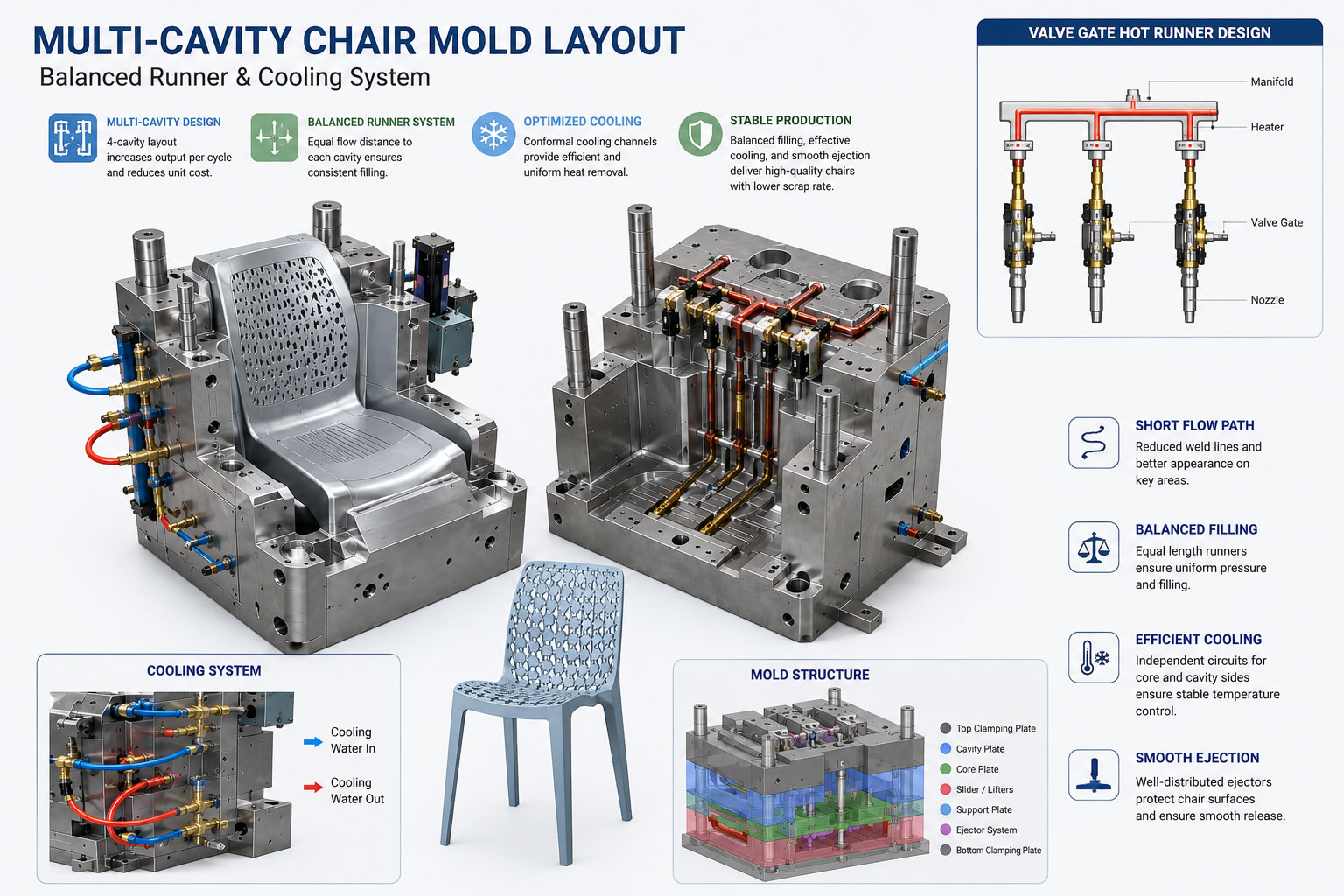
A multi cavity chair mold can produce more parts per cycle, reducing the share of
machine time, labor, and mold amortization assigned to each part. For high-volume, low-margin chair products,
this can be one of the most direct ways to lower unit cost.
| Comparison Area | Single-Cavity Mold | Four-Cavity Mold Example |
|---|---|---|
| Output per cycle | 1 part | 4 parts |
| Tooling amortization | Higher per part | Shared across more parts |
| Machine occupation per part | Baseline | Lower when clamping force and shot size are suitable |
| Initial mold investment | Lower | Higher, but stronger long-term cost potential |
Design Challenges of Multi-Cavity Chair Molds
More cavities do not automatically mean a better mold. Chair size, projected area,
clamping force, tie-bar distance, shot weight, and mold weight all limit cavity count. A standard household
chair may already require a large-tonnage machine. Doubling the cavity count can require a larger press and
higher mold investment.
- Runner balance must allow each cavity to fill at similar pressure and timing.
- Gate position should avoid weld lines in structural load-bearing areas.
- Cooling performance must be consistent across all cavities.
- Steel grade and mold structure must handle higher pressure and wear.
How to Choose the Right Cavity Number
| Annual Volume | Recommended Cavity Strategy | Procurement Consideration |
|---|---|---|
| Below 50,000 parts | Single cavity | Lower initial mold cost for pilot production or market validation |
| 50,000–200,000 parts | Two cavities where machine capacity allows | Balances tooling investment and production efficiency |
| 200,000–500,000 parts | Four cavities for suitable parts or components | Improves unit cost when long-term demand is clear |
| Above 500,000 parts | Higher-cavity strategy after technical review | Requires careful evaluation of machine tonnage, balance, cooling, and mold durability |
Reducing Material Waste in Chair Injection Molding
Material waste occurs during mold manufacturing and injection molding. It may
come from oversized mold blocks, excessive machining allowance, runner scrap, gate waste, flash, process
instability, or rejected parts.
For high-volume chair production, material control must be engineered into the mold
structure and molding process instead of corrected only after defects appear.
Mold Manufacturing Waste
Mold material cost can represent a meaningful portion of the tooling budget. Waste can
be reduced by optimizing mold base dimensions, using replaceable cavity inserts, and controlling machining
allowance. Modular insert design is especially useful for chair molds because worn or damaged areas can be
replaced without rebuilding the entire tool.
Runner and Gate Waste
The runner system is a major material consideration in chair injection molding. A hot
runner system can reduce solidified runner scrap compared with a cold runner system, especially in continuous
production. Gate size and position also influence pressure loss, weld-line location, flash risk, and cosmetic
quality.
DTG evaluates resin type, expected volume, part geometry, and production cost targets
before recommending cold runner, hot runner, or hybrid solutions as part of an integrated injection molding
manufacturing plan.
Scrap Rate Control
Reducing scrap rate has a direct effect on profit. Moving from unstable molding to a
controlled process requires moldflow prediction, disciplined trial records, stable processing windows, and
quality monitoring. For chair products, common scrap causes include warpage, flash, short shots, burn marks,
deformation, ejection marks, and surface sink.
| Waste Source | Typical Cause | Control Method |
|---|---|---|
| Repeated trial modifications | Insufficient DFM or moldflow review | Review geometry, filling, cooling, and ejection before machining |
| Runner scrap | Cold runner waste or long flow path | Optimize runner length, gate position, and hot runner feasibility |
| Flash and trimming labor | Poor fitting, excessive pressure, or parting-line wear | Improve mold fitting, venting, steel hardness, and process control |
| Rejected molded parts | Unstable parameters or uneven cooling | Use SPC, visual inspection, and controlled molding windows |
Extending Mold Life to Lower Cost Per Shot
Mold Steel Selection
Mold steel should match the expected production life. More expensive steel is not always
necessary, but under-specifying steel can shorten mold life and increase downtime. For standard PP chair
production, P20 may be suitable for moderate volumes. For longer-life molds, reinforced materials, or export
requirements, 2738, 718, H13, or 2344 may offer stronger lifecycle economics.
| Steel Grade | Typical Application | Procurement Logic |
|---|---|---|
| P20 | Standard PP or PE chairs with moderate production volume |
Controls upfront cost when lifecycle demand is limited |
| 2738 / 718 | Medium and large chair molds with higher appearance requirements |
Balances durability, polishability, and cost |
| H13 / 2344 | High-volume molds or glass-filled materials | Improves wear resistance and lifecycle value |
| S136 / NAK80 | High-polish, corrosion-resistant, or special surface applications |
Used where surface performance or resin behavior requires it |
Surface Treatment
Surface treatments can extend mold life and reduce maintenance frequency. Nitriding
improves surface hardness and wear resistance. Hard chrome plating can reduce friction and improve corrosion
resistance, especially when recycled resin is used. PVD coating can further improve wear and thermal fatigue
resistance for demanding production conditions.
Maintenance Planning
- Per shift: lubricate ejector pins, guide pillars, and slides;
clean plastic residue; check water flow. - Every 50,000–100,000 shots: clean vents, inspect ejector wear,
repair damaged surfaces, and verify cooling channels. - Long-term storage: apply rust protection, close the mold
properly, and seal it against dust and moisture.
Need an Engineering Review Before Quotation?
Share your 3D model, resin selection, expected annual volume, surface requirements,
and production plan. DTG can review moldability, cavity strategy, cooling layout, and steel selection before
tooling decisions are finalized.
Contact
DTG for DFM and Moldability Support
Choosing the Right Chair Mold Manufacturer
Why the Lowest Quote Can Be Expensive
A low mold price can hide risks such as non-standard steel substitution, skipped stress
relief, simplified heat treatment, limited polishing control, weak mold fitting, or insufficient trial support.
The result may be higher scrap, repeated downtime, short mold life, and higher total cost during production.
Supplier Evaluation Factors
| Evaluation Area | What Procurement Should Check |
|---|---|
| Relevant mold experience | Plastic chair, stool, furniture, or large household product tooling experience |
| Material transparency | Steel grade documentation and clear agreement on mold material |
| Engineering support | DFM report, moldflow review, cooling analysis, and design optimization advice |
| Trial and after-sales support | Defined trial process, modification support, warranty terms, and response mechanism |
| Export mold standards | Familiarity with DME, HASCO, MISUMI, spare parts, and export packaging requirements |
DTG TECH’s Integrated Approach
DTG TECH supports mold projects from design evaluation and mold manufacturing to trial
samples, modification, and production handover. For chair mold programs, our engineering team focuses on
lifecycle cost optimization instead of simply reducing the initial mold price.
- DFM and moldflow review before mold manufacturing.
- Transparent steel selection based on production life and material requirements.
- In-house mold processing, trial support, and structured progress reporting.
- Experience with export mold standards and industrial project communication.
To understand how process control affects delivery stability and mold durability, you
may also review DTG’s mold
manufacturing capabilities.
Conclusion: Reduce Cost by Engineering the Whole Mold Lifecycle
Reducing the cost of plastic chair molds is not achieved by selecting the lowest tooling
quote. It is a system-level process that begins with product design and continues through mold structure,
cooling system, cavity strategy, material utilization, mold steel, surface treatment, maintenance, and supplier
selection.
For procurement managers and engineers, the most practical benchmark is cost per
qualified part. A mold with stronger design review, stable cooling, suitable cavity count, and planned
maintenance can reduce molding costs while improving dimensional stability and production consistency.
If your team is planning a new chair injection mold project, DTG can help evaluate moldability,
lifecycle cost, and production feasibility before tooling investment begins.