How to Choose a Reliable Custom Plastic Chair Manufacturer
Choosing a reliable custom plastic chair manufacturer is more important than finding the lowest number on a quotation sheet. Unstable mold quality, material substitution, delayed delivery, weak process control, and slow after-sales response often come from an incomplete supplier evaluation process.
For OEM brands, furniture importers, project contractors, and procurement teams, the right manufacturer should provide more than molded parts. A qualified partner should understand mold engineering, material selection, production validation, quality control, delivery planning, and long-term cost management.
Why Choosing the Right Manufacturer Matters
A plastic chair project connects product design, mold manufacturing, material formulation, injection molding, inspection, packaging, and shipment. If one link is weak, the result may be warpage, sink marks, flash, structural cracking, color inconsistency, or shipment delay.
A dependable OEM plastic chair supplier should reduce project risk by identifying manufacturing issues early, validating the mold before mass production, and maintaining stable communication throughout the project.

Evaluate Mold Manufacturing Capability
Design Capability: CAD, CAE, CAM, and DFM
Mold quality begins before steel cutting. A professional plastic chair factory should be able to review the product structure, identify uneven wall thickness, insufficient draft angle, unreasonable undercuts, weak rib design, and potential demolding risks before tooling starts.
DFM and moldflow analysis are especially important for large plastic chairs. They help predict melt flow, weld line position, air traps, cooling efficiency, and potential warpage. For buyers reviewing chair mold capability, DTG’s plastic chair injection mold page explains large-part chair mold support for stackable, outdoor, dining, and commercial plastic chairs.
Machining Capability: CNC, EDM, CMM, and Heat Treatment
Plastic chair molds often require large curved cavity surfaces, deep ribs, narrow slots, textured areas, and accurate parting lines. A capable manufacturer should have CNC machining, EDM, wire cutting, deep-hole drilling, precision grinding, polishing, and dimensional inspection capability.
CMM inspection helps control critical mold dimensions, while proper stress management and heat treatment improve mold life and dimensional stability. This is one reason procurement teams should review actual processing capability, not only the quoted mold price.
Mold Trial Capability: Injection Machines and Production Validation
A manufacturer with in-house trial molding can validate the tool before shipment or mass production. T0 to T2 trials should check filling, venting, ejection, weld lines, surface quality, cycle time, and process window stability. For large chairs, the factory should have access to suitable injection molding machines, typically ranging from several hundred tons to more than 1,000 tons depending on projected area and part weight.
Check Material and Quality Standards
Material Selection Expertise
A reliable commercial plastic chair manufacturer should recommend materials based on the application. PP may be suitable for lightweight, stackable, cost-controlled chair projects. HDPE may be more appropriate for outdoor, poolside, coastal, or long-life seating. UV stabilizers, antioxidants, color masterbatch, and impact modifiers should be specified according to the target market and environment.
Quality Certifications and Compliance
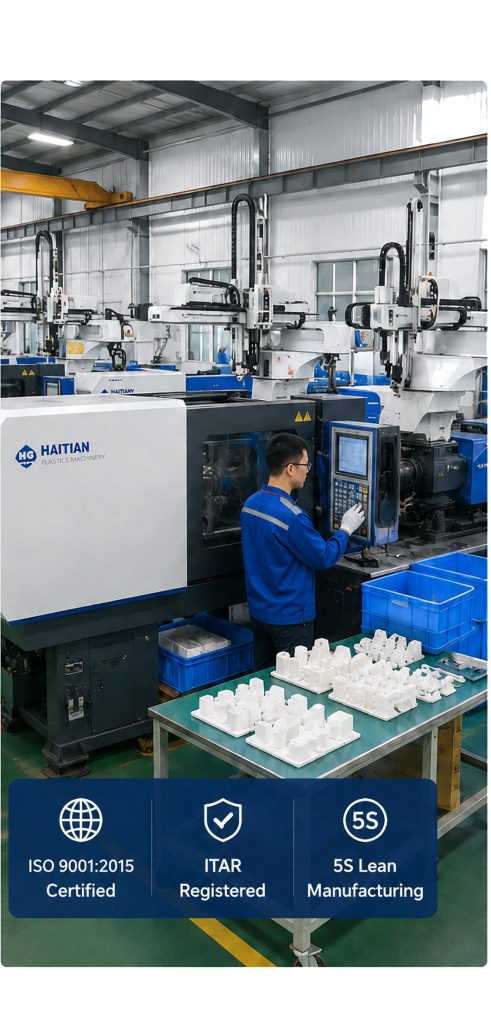
ISO 9001 certification is a useful baseline for evaluating quality management. For export projects, buyers may also need REACH, RoHS, or other compliance documentation depending on the target market. The supplier should be able to provide material reports, production records, inspection data, and traceability documents when required.
Testing and Validation Capability
Finished chairs may require load testing, impact testing, color fastness review, UV exposure testing, and dimensional inspection. A serious supplier should understand these requirements and support third-party testing when the project or market requires it.
Review Production Capacity
Injection Molding Machine Range
Machine tonnage directly affects whether a factory can produce large chairs reliably. Small chairs may require lower tonnage, while standard household chairs and large outdoor chairs often require machines in the 600–1300 ton range. Insufficient clamping force can cause flash, poor dimensional control, and unstable production.
Capacity and Supply Chain Stability
Buyers should review machine quantity, tonnage distribution, shift arrangement, peak capacity, and historical delivery performance. A stable raw material supply chain is also important because resin price changes and material shortages can affect both cost and lead time.
In-Process Quality Control and Traceability
A complete quality system should include incoming material inspection, first article inspection, in-process sampling, final inspection, and pre-shipment inspection. Batch traceability should record material lot, process parameters, inspection results, and production date.
For outdoor chair projects requiring stable delivery, cost control, and engineering support, DTG’s OEM plastic outdoor chair manufacturing page provides a closer look at production-oriented outdoor seating support.
Understand OEM Customization Support
Product Design and Mold Development
OEM projects often require customized color, logo, surface texture, stacking structure, ergonomic adjustment, or material selection. The manufacturer should provide DFM feedback before mold design, then recommend suitable cavity numbers, mold standards, gate strategy, and runner design based on the annual volume.
Production Lead Time and Delivery Control
A clear schedule should cover mold design, steel preparation, machining, fitting, trial molding, modification, sample approval, mass production, packaging, and shipment. Weekly progress updates with photos or videos help reduce communication gaps and delivery uncertainty.
Cost Optimization Support
Experienced manufacturers can help buyers balance initial mold investment and unit production cost. Cavity number, resin grade, wall thickness, hot runner selection, cycle time, and packaging method all influence the total cost structure.
Procurement Note: Do Not Evaluate Only the Unit Price
A low unit price may hide material substitution, weak mold steel, poor cooling design, unstable cycle time, or limited after-sales support. For OEM chair programs, compare suppliers by lifecycle cost, defect risk, delivery control, and engineering response.
Why Engineering Support Matters
Early DFM Review
DFM review helps prevent common defects before mold cutting. For plastic chairs, this includes checking wall thickness, ribs, draft angles, gate feasibility, stacking features, weak structural areas, and demolding risks.
Moldflow Analysis
Moldflow analysis helps verify filling balance, weld line location, air traps, cooling efficiency, and warpage tendency. This reduces trial-and-error modification and supports more predictable mold development.
Process Parameter Support
After trial molding, the supplier should provide process references such as melt temperature, mold temperature, injection speed, holding pressure, cooling time, and cycle time. These records help maintain production consistency when the mold moves into batch manufacturing.
Mold Maintenance and After-Sales Support
A strong manufacturer should provide mold maintenance guidance and respond quickly when production issues occur. Mold ownership, spare parts, warranty scope, repair responsibility, and response time should be clarified before project launch.
For buyers evaluating tooling suppliers, DTG’s plastic mold manufacturing service outlines mold processing capability with CNC machining, ISO-certified production control, and industrial-grade mold support.

Questions to Ask Before Starting an OEM Chair Project
A structured question list helps procurement teams compare suppliers more objectively. The goal is to verify real manufacturing capability, not just sales claims.
These questions can be used during supplier qualification, video meetings, factory audits, or quotation comparison.
| Evaluation Area | Questions to Ask |
|---|---|
| Mold manufacturing | Do you use CAD, CAE, and CAM systems? Can you provide DFM examples for plastic chair molds? What CNC, EDM, and CMM equipment do you have? |
| Materials and quality | Can you provide PP or HDPE material reports? Do you support UV-stabilized materials? Do you have ISO 9001, REACH, or RoHS documentation if required? |
| Production and delivery | What is your injection machine tonnage range? What is the monthly capacity? What is the lead time for first samples and mass production? |
| OEM customization | Can you customize color, logo, surface texture, and packaging? What is the MOQ? Is DFM included before mold production? |
| Engineering support | Do you provide moldflow analysis, trial reports, process parameter cards, and mold maintenance guidance? |
| Commercial terms | Who owns the mold? What are the payment terms? Is an NDA available? How is customer product data protected? |
For additional cost-planning context, DTG’s article on how plastic chair injection molds reduce production costs explains how DFM, cooling optimization, cavity layout, material waste control, and mold life planning affect total project economics.
Planning a Custom Plastic Chair OEM Project?
Share your 3D files, target material, expected annual volume, chair application, surface requirements, and target market. DTG’s engineering team can review moldability, material selection, tooling strategy, and production feasibility before quotation.
Contact DTG for DFM and OEM Project Review
Conclusion: Choose a Manufacturing Partner, Not Just a Supplier
Selecting a custom plastic chair manufacturer is a system-level decision. Procurement teams should evaluate mold manufacturing capability, material knowledge, quality standards, production capacity, OEM customization support, engineering service, delivery control, and commercial transparency.
DTG TECH supports plastic chair OEM projects from material selection and mold design to moldflow analysis, tooling, sampling, modification, and batch injection molding. With experience in plastic chair mold projects and export mold standards, DTG helps buyers reduce development risk and improve production stability.
For a new plastic chair program, the right partner should not only manufacture parts, but also help protect your timeline, quality expectations, and lifecycle cost.