
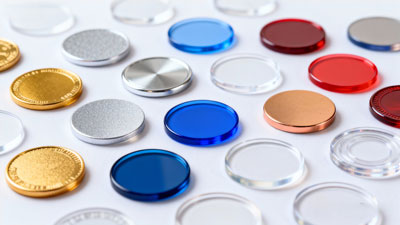
ABS vs PVC vs Polycarbonate: Choosing the Right Plastic for Your Custom Tokens
For procurement managers and product owners sourcing custom plastic coins, material choice directly affects product durability, compliance, cost control, and delivery reliability. Whether you are ordering plastic custom coins for retail loyalty programs, gaming tokens, promotional giveaways, or industrial identification, understanding the differences between ABS, PVC, and Polycarbonate is essential.
This article provides a material-focused comparison designed for buyers evaluating custom made plastic coins, including bulk orders, pilot runs, and custom plastic coins no minimum production. We also answer common sourcing questions such as how to make plastic coins and how much does it cost to make a custom coin, while sharing a real collaboration case with a European client.
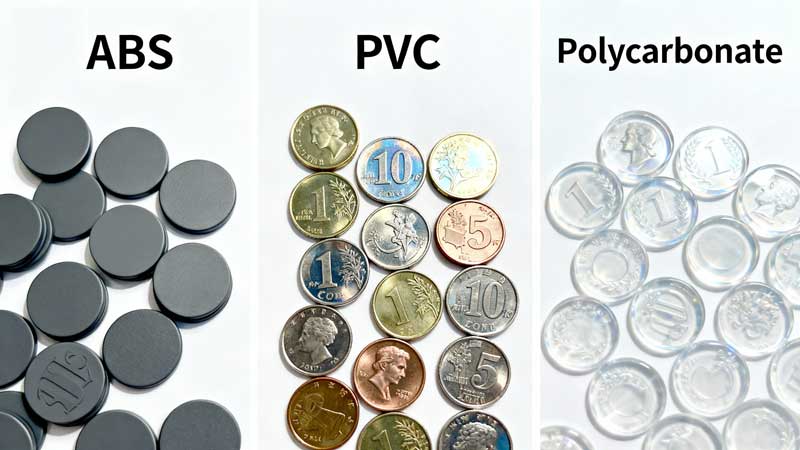
ABS vs PVC vs Polycarbonate: Material Performance Comparison
| Performance Factor | ABS | PVC | Polycarbonate (PC) |
|---|---|---|---|
| Impact Resistance | High | Medium | Very High |
| Surface Finish | Matte / Gloss / Plated | Smooth / Flexible Feel | Glossy / Transparent |
| Temperature Tolerance | -20°C to 80°C | -10°C to 60°C | -40°C to 120°C |
| Print & Branding Options | Screen, pad, UV print | Screen, pad print | Laser engraving, UV print |
| Best Use Cases | Custom plastic challenge coins | Promotional plastic coins bulk | Premium or long-life tokens |
For buyers searching for a reliable plastic coin maker, this comparison helps quickly match performance expectations with budget and lifecycle requirements.
Food-Grade & Compliance Certification Requirements
Many buyers ask whether plastic custom coins can meet food-contact or child-safety regulations. This is especially relevant for vending tokens, supermarket loyalty coins, and family entertainment centers.
- ABS: Can comply with FDA and EU RoHS standards when certified raw materials are used. Common for durable custom plastic challenge coins.
- PVC: Widely used for low-cost tokens. Food-grade formulations are available with strict additive control.
- Polycarbonate: Suitable for FDA and EU food-contact compliance. Often chosen for reusable or premium custom plastic gold coins.
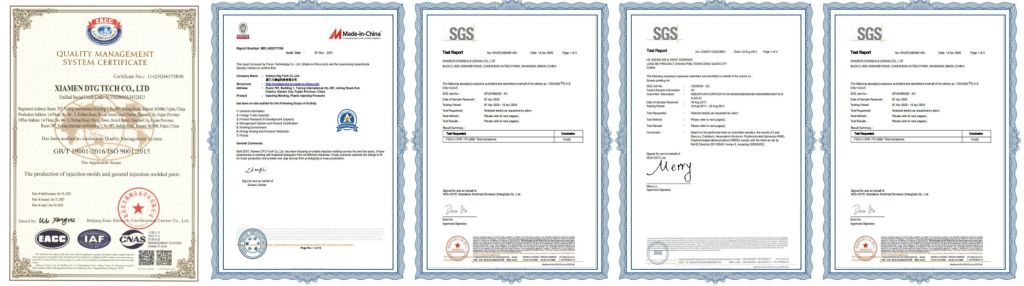
At DTG TECH, all materials are traceable, and certification documents are provided before mass production—reducing compliance risk for overseas buyers in the EU, US, and Australia.
Durability Testing Data for Custom Plastic Coins
Durability is a key factor when evaluating custom plastic coins bulk orders. Breakage, surface wear, or deformation increases replacement frequency and total cost.
Based on internal testing following ISO impact and abrasion standards:
- ABS coins: Survived over 5,000 drop cycles at 1.5 meters with minimal edge damage.
- PVC coins: Maintained structural integrity but showed visible surface wear after extended circulation.
- Polycarbonate coins: Exceeded 10,000 impact cycles with no cracking, ideal for high-traffic environments.
These tests are conducted during the Plastic Injection Molding validation phase to ensure stable quality before shipment.
Cost-Benefit Analysis: Beyond Unit Price
One of the most common sourcing questions is how much does it cost to make a custom coin. While unit price matters, experienced procurement teams focus on total cost of ownership.
- ABS: Balanced option with moderate tooling cost and long service life.
- PVC: Lowest per-unit cost, ideal for short-term promotions and plastic coins bulk orders.
- Polycarbonate: Higher raw material cost, but significantly reduced replacement and warranty expenses.
When evaluating custom challenge coins cost, factors such as mold lifespan, defect rate, and delivery stability often outweigh small differences in material pricing.
| Material | Cost per Unit (USD) | MOQ | Lead Time (Sample) | Durability | UV Resistance | Food Grade | Best For |
|---|---|---|---|---|---|---|---|
| ABS | $0.12 – $0.25 | 1,000 pcs | 10–12 days | High impact strength, good toughness | Moderate (requires coating) | No (unless certified) | Casino tokens, arcade coins, promotional items |
| PVC | $0.08 – $0.18 | 2,000 pcs | 12–15 days | Flexible, decent durability | Poor (yellows over time) | Optional (FDA grades available) | Drink tokens, event passes, low-cost giveaways |
| Polycarbonate (PC) | $0.25 – $0.45 | 500 pcs | 14–18 days | Excellent strength, transparent options | Excellent | No | High-end challenge coins, transparent tokens, military/commemorative coins |
| PETG | $0.15 – $0.30 | 1,500 pcs | 10–14 days | Good clarity, chemical resistant | Good | Yes (FDA compliant) | Custom drink tokens, food-safe applications, eco-friendly lines |
| Acrylic (PMMA) | $0.30 – $0.60 | 500 pcs | 15–20 days | Glass-like clarity, scratch resistant | Excellent | No | Luxury tokens, award coins, display items |
| Recycled Plastic (rPET/ABS mix) | $0.10 – $0.22 | 3,000 pcs | 12–16 days | Variable (depends on blend) | Moderate | Depends on source | Sustainable brands, CSR promotions, green events |
Recommended Application Scenarios
Different industries require different material priorities:
- Retail & Loyalty Programs: PVC or ABS custom printed plastic coins.
- Arcades & Gaming: ABS or PC for impact resistance.
- Premium Branding: ABS-based custom plastic gold coins with metallic plating.
- Industrial Access & Control: Polycarbonate tokens for extreme durability.
- Regional Supply: DTG TECH frequently supplies custom plastic tokens Australia with full compliance support.
View examples on our custom plastic tokens product page.
Real Case Study: Germany Retail Loyalty Token Project
Country: Germany
Client: A nationwide supermarket chain
Procurement Type: Centralized EU purchasing department
The client required 800,000 custom plastic coins for a reusable loyalty campaign. Key requirements included EU compliance, consistent gold color, strict delivery deadlines, and cost optimization compared to their previous supplier.
DTG TECH recommended ABS with vacuum metallic plating, producing durable custom plastic gold coins. Through optimized mold design and parallel tooling production, delivery time was reduced by 22%.
The client confirmed that product quality exceeded expectations, defect rates dropped below 0.3%, and overall campaign costs were reduced due to longer coin lifespan. The procurement team highlighted smooth English communication and reliable project management as major advantages.
FAQ
How do you make custom coins?
Custom coins are produced through mold design, injection molding, surface finishing, and quality inspection.
Can I order custom plastic coins with no minimum?
Yes. Prototype and small-batch production are available before scaling to bulk manufacturing.
Do banks take plastic coin wrappers?
Bank policies vary by country, but many accept plastic coin wrappers that meet size standards.
How do you use plastic coin wrappers?
They are used for sorting, counting, and transporting coins or tokens efficiently.
Conclusion: Choose the Right Material with Confidence
Selecting the right material for custom plastic coins directly impacts compliance, durability, cost efficiency, and delivery reliability. With over 20 years of experience in mold manufacturing and injection molding, DTG TECH supports buyers from prototype to mass production.
If you are planning a new plastic custom coins project, contact our team for material recommendations, cost analysis, and a fast, transparent quotation.
 DTG Mould Trade Process |
|
| Quote: | According to sample, drawing and specific requirement. |
|---|---|
| Discussion | Mold material, cavity number, price, runner, payment, etc. |
| S/C Signature | Approval for all the items. |
| Advance | Pay 50% by T/T |
| Product Design Checking | We check the product design. If some position is not perfect, or can not be done on the mould, we will send customer the report. |
| Mold Processing | Send report to customer once each week |
| Mold Testing | Send trial samples and try-out report to customer for confirmation |
| Mold Modification | According to customer’s feedback. |
| Balance Settlement | 50% by T/T after the customer approved the trial sample and mould quality. |
| Delivery | Delivery by sea or air. The forwarder can be designated by your side. |
 |
|