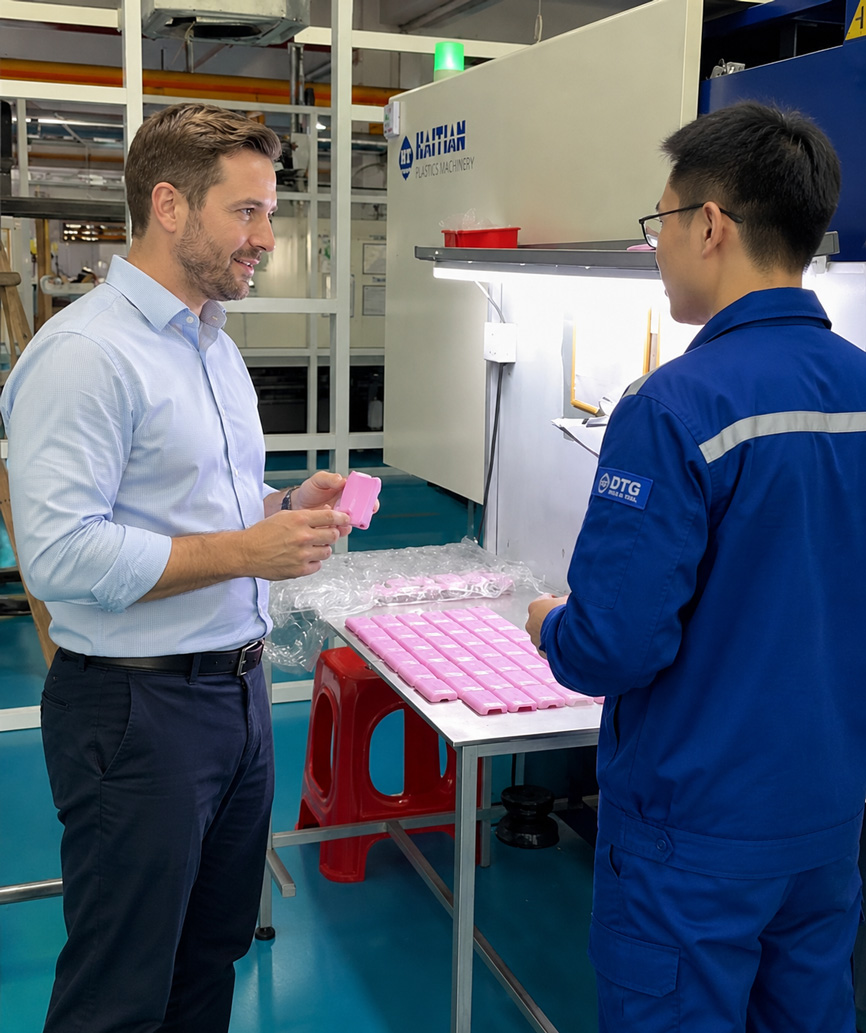
Two Shot Sports Water Bottle Cap Manufacturer | Our Factory
Two Shot Sports Water Bottle Cap | Sports Water Bottle Cap Manufacturer
For OEM teams developing our Two Shot Sports Water Bottle Cap, the real challenge is not simply adding a soft-touch surface. Our cap must maintain sealing reliability, hinge and locking performance, PP/TPE bonding,dimensional consistency and an acceptable cosmetic standard while remaining practical for repeatable mass production.
Two-Shot Sports Bottle Cap Manufacturing Overview
Our factory supports custom mold development and precision injection molding from DFM analysis through tooling, mold trials and production. For bottle-cap programs, our engineering focus is on process repeatability, material compatibility, functional interfaces and production stability rather than cosmetic appearance alone.
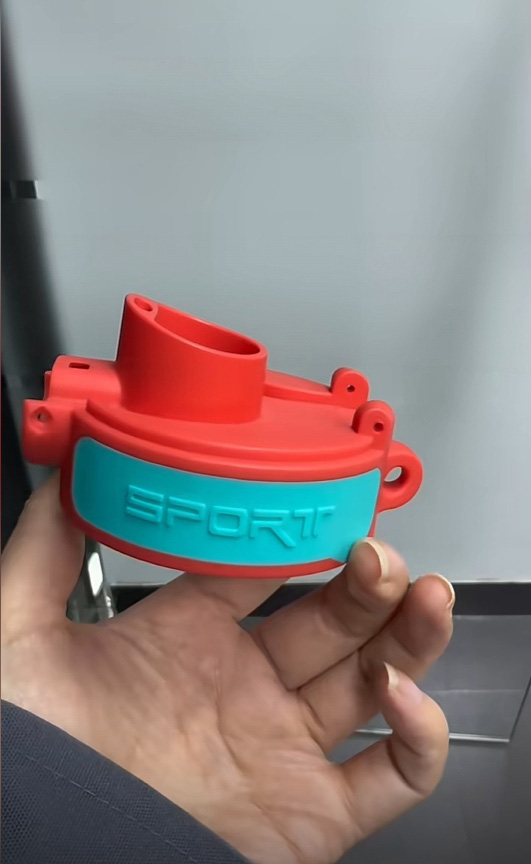
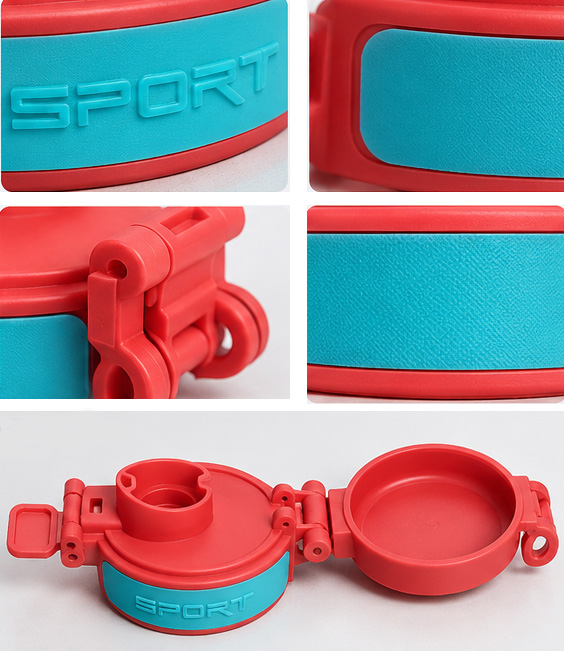
The illustrated component is our two-shot molded sports bottle lid using a rigid PP structural body and a soft TPE overmold. The PP section forms the primary housing, assembly interfaces, hinge-related geometry and locking features. The TPE section is applied locally to create an anti-slip gripping zone and integrated raised branding.
A properly engineered PP and TPE Sports Bottle Cap can combine structural performance and tactile functionality within one coordinated molding process. Compared with manufacturing a rigid cap and subsequently installing or bonding a separate soft component, the two-shot approach can reduce handling steps and improve repeatability between the hard and soft sections.
As a Sports Water Bottle Cap Manufacturer and custom mold supplier, we evaluate product geometry, resin behavior, molding sequence, gate position, cooling requirements and overmold retention before tooling release.
Related manufacturing capability:: our Precision Plastic Injection Molding Services .
Common Production Issues & Engineering Solutions
Our two-material lid requires coordinated control of mold construction, material selection and processing conditions. The following issues are typical considerations during tooling qualification and serial production.
| Common Production Issue | Possible Cause | Recommended Engineering Approach |
|---|---|---|
| TPE edge lifting or local delamination | Material incompatibility, insufficient mechanical retention or unsuitable interface geometry | We recommend verifying PP/TPE grade compatibility and optimizing grooves, through-holes, undercuts or other mechanical interlock features where required |
| Flash around the TPE boundary | Insufficient shut-off accuracy, mold mismatch, excessive second-shot pressure or local steel deflection | We recommend reviewing shut-off geometry, mold rigidity and second-shot process parameters before production approval |
| Incomplete filling in soft-grip areas | Long TPE flow path, inadequate venting, restrictive gate design or unsuitable processing conditions | We recommend optimizing gate dimensions and flow direction, improving venting and establishing a validated molding window during mold trials |
| Burn marks or trapped gas | Air accumulation at end-of-fill locations | We recommend adding or relocating venting features and considering enhanced venting solutions for enclosed or thin-wall overmold regions |
| Cap warpage or dimensional variation | Non-uniform PP wall thickness, cooling imbalance or uneven shrinkage | We recommend optimizing structural wall thickness and cooling layout and verifying critical dimensions after complete thermal stabilization |
| Visible weld lines | Unfavorable gate location or material flow-front meeting position | We recommend adjusting gate strategy and flow path to move weld lines away from critical cosmetic or functional regions where possible |
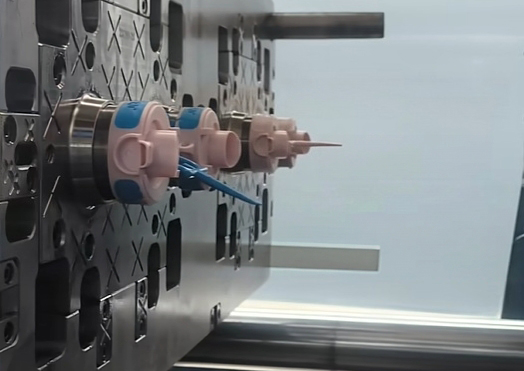
| Unstable second-shot positioning | Transfer, rotary platen, rotary core or index-plate positioning deviation | We recommend verifying mechanical repeatability between first-shot and second-shot positions during mold qualification |
| Leakage after assembly | Deformed sealing interface, dimensional stack-up, flash or mismatch with mating components | We recommend defining sealing-critical dimensions during DFM and validating assembled parts using leakage or air-tightness testing |
Key Manufacturing Advantages of Two-Shot Molding
Integrated Hard-Soft Construction
Our rigid PP body and soft TPE contact zones are produced within our coordinated mold system, integrating mechanical structure and tactile functionality into one molded component.
Reduced Secondary Assembly
Localized soft-grip areas can be molded directly onto our structural component, reducing the need for separate soft parts, manual fitting or selected bonding operations.
Repeatable Material Positioning
Our controlled transfer system provides repeatable positioning between the first and second shots, helping maintain consistent overmold boundaries.
Integrated Surface Design
Raised logos, contrasting colors, local matte textures and soft-touch areas can be incorporated into the molded geometry without relying solely on post-molding decoration.
Production-Oriented DFM
Tooling feasibility, material interfaces, wall thickness, gate position, venting and cooling are reviewed before steel cutting to reduce avoidable manufacturing risk.
Scalable Production Strategy
Our mold validation and process-window development are carried out with repeatable batch production in mind, not only initial sample acceptance.
Product Structure: First-Shot PP and Second-Shot TPE
The performance of our Two Shot Sports Water Bottle Cap depends on the relationship between the structural substrate and the overmolded material. Each material should have a clearly defined function.
First Shot: Rigid PP Structural Body
Our first shot uses an appropriate food-contact PP grade to form the main mechanical structure.
- Outer cap housing
- Thread connection geometry
- Flip-top or opening mechanism
- Hinge-related features
- Locking or latching geometry
- Assembly positioning features
PP is commonly selected for reusable bottle-cap structures because it offers low density, chemical resistance, fatigue resistance and competitive material economics, subject to the required resin grade and compliance specification.
Second Shot: Soft TPE Grip Area
Our second shot applies TPE to defined external regions of the PP substrate.
- Anti-slip gripping surfaces
- Raised brand or logo areas
- Decorative color sections
- Localized soft-touch surfaces
- High-friction hand-contact zones
TPE offers a softer tactile response, useful friction characteristics, coloring flexibility and wear resistance depending on the selected grade and product environment.
Why Two-Shot Injection Molding Fits Sports Bottle Lid Programs
Material Retention
The second material is molded directly against our first-shot substrate. With suitable resin compatibility and correctly designed retention geometry, this approach can reduce the risk of soft-layer separation during repeated use.
Wet-Environment Grip
TPE can be placed specifically in hand-contact areas to provide additional surface friction when the component is exposed to condensation, perspiration or outdoor moisture.
Functional Appearance Integration
A contrasting TPE section can serve both an engineering function and a product-identification function, including molded logos and controlled texture changes.
Two-Shot Molding vs. Separate Overmolding and Assembly
The appropriate process depends on component geometry, required volumes, tooling budget and automation objectives. For suitable high-repeatability applications, integrating the second material into the molding sequence can simplify downstream handling.
Conventional Multi-Step Route
Integrated Two-Shot Route
Recommended Material Combinations
Resin pairing should be evaluated according to adhesion requirements, regulatory needs, mechanical performance, chemical exposure, tactile requirements and the intended product environment. Generic material-family compatibility should not replace grade-specific validation.
| Structural Material | Overmold Material | Typical Characteristics | Typical Application |
|---|---|---|---|
| PP | TPE | Food-contact grade options, soft-touch surface and anti-slip functionality | Sports bottles, fitness bottles and drinking lids |
| PP | TPU | Potentially improved abrasion resistance depending on selected grades | Outdoor hydration components |
| PC | TPU | Transparent rigid substrate with soft functional areas | Selected premium drinking products |
| ABS | TPE | Good cosmetic capability for non-food-contact applications where appropriate | Household and consumer components |
| PA | TPE | Higher mechanical strength for appropriate engineering applications | Industrial hard-soft molded components |
DFM Considerations for a PP and TPE Sports Bottle Cap
Our reliable two-shot component requires more than adding a soft layer to an existing rigid design. The interface must be engineered as part of the complete molded structure.
Overmold Coverage
Too little TPE coverage can reduce retention area or create difficult filling conditions. Excessive coverage can increase resin consumption, cooling demand and cycle time. The target area should be driven by functional requirements.
Wall Thickness
More uniform PP wall sections and controlled TPE thickness help reduce localized shrinkage, sink and deformation. Large thickness transitions should be reviewed during DFM.
Mechanical Interlock
Grooves, holes, undercuts and other molded retention features can supplement material adhesion and improve mechanical resistance to peeling or separation.
Logo Integration
Raised lettering such as the logo shown on the sample can be integrated directly into the TPE zone, eliminating the need for a separate printed label in suitable designs.
Sealing Interface Control
Thread locations, seal-contact surfaces and mating interfaces should be protected from flash, distortion and unnecessary material transitions.
Tolerance Stack-Up
Cap dimensions must be reviewed together with the bottle neck, seal, hinge and locking mechanism. Functional acceptance should not rely on isolated dimensions alone.
Two-Shot Mold Design Considerations
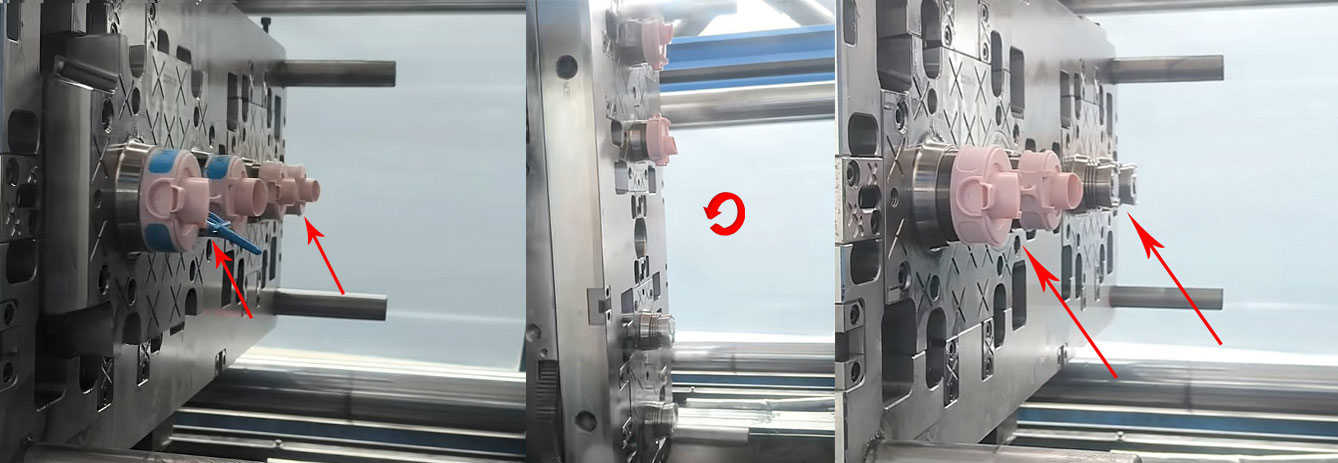
Rotation & Transfer Structure
Rotary platen, rotary core or index-plate concepts may be selected according to part geometry, mold configuration and machine requirements.
Gate Location
Gate design influences fill balance, weld-line location, surface appearance, pressure demand and the quality of the material interface.
Venting Strategy
Thin or enclosed TPE regions can trap air. Vent locations should be aligned with expected end-of-fill areas to reduce short shots and burn marks.
Cooling Layout
The rigid and soft material stages may place different thermal demands on the mold. Balanced cooling supports cycle-time control and dimensional consistency.
Shut-Off Accuracy
Accurate shut-off geometry around TPE boundaries is required to minimize flash and maintain defined color and material separation lines.
Transfer Repeatability
Positioning repeatability between the first and second molding stations must be verified before production release.
Two-Shot Mold Development and Production Process
We use an engineering-led development sequence to move a project from product data to tooling validation and serial production.
Our project engineers follow tooling progress, trial results, required modifications and sample approval. The objective is to identify and close technical issues before full production volumes are released.
Quality Control for Sports Bottle Cap Production
Our Leak Proof Sports Bottle Cap depends on the complete cap-and-container system. Molded dimensions, sealing interfaces, hinge durability and material retention should therefore be evaluated against the final assembly requirements.
Dimensional Inspection
Critical molded dimensions can be checked using CMM, height gauges, optical measurement equipment and other suitable inspection methods.
PP/TPE Retention Verification
The overmold interface can be evaluated to identify weak bonding, peeling or insufficient mechanical retention before production approval.
Leakage & Air-Tightness Testing
Finished assemblies may be evaluated through leakage or air-tightness testing according to the bottle design, seal system and customer specification.
Opening / Closing Life Test
Repeated-use testing helps assess hinge durability, locking reliability and wear in high-contact regions.
Appearance Inspection
Inspection criteria can cover flash, weld lines, short shots, color variation, burn marks, sink, silver streaks and surface contamination.
Production Consistency
Approved samples, critical dimensions and validated processing conditions provide reference standards for later production batches.
Typical Applications for Custom Sports Bottle Lids
As an OEM Plastic Sports Bottle Lid Supplier, we can adapt the hard-soft molding concept according to product geometry, material requirements, surface design and expected production volume.
Application Case: Two Shot Sports Water Bottle Cap
The sample we show on this page integrates a rigid red structural body with a contrasting blue soft-grip section. The raised lettering is formed directly in the TPE area, allowing the soft section to provide both grip functionality and molded brand identification.
During development of this type of component, our main engineering priorities include the PP/TPE interface, overmold shut-off, second-shot filling behavior, transfer positioning, cooling balance and dimensional control around assembly features.
Our development approach focuses on establishing a process that can reproduce the approved component consistently instead of optimizing only for the first trial sample.
Why OEM Buyers Work with Our Factory for Bottle Cap Tooling & Molding
Our factory specializes in custom mold making and injection molding, providing engineering support from mold design to mass production. For OEM sourcing teams, supplier performance involves more than molded-part price: tooling reliability, technical response, production consistency, schedule control and issue resolution all affect the total program cost.
DFM Before Tooling
Product geometry is reviewed for molding feasibility, material interfaces, tolerance risks, cosmetic requirements and assembly considerations before mold manufacturing.
Custom Mold Development
Tool design is developed around the actual product structure, resin behavior, production volume and quality requirements.
Mold Trial Validation
Trial samples are evaluated and required tooling or process modifications are completed before final production approval.
Small & Large Production Runs
Production planning can support pilot quantities, validation batches and ongoing volume requirements according to the program.
Project Communication
Tooling progress, trial status, technical findings and required modifications are communicated through defined project stages.
Production Quality Control
Critical dimensions, functional requirements and appearance criteria can be incorporated into the project inspection plan.
Our Mold and Injection Molding Project Workflow
| Stage | Project Activity | Purpose |
|---|---|---|
| 1. Quote & Discussion | Review 2D/3D files, resin requirements, expected volume and quality specifications | Clarify technical scope and commercial assumptions |
| 2. S/C Confirmation | Service and commercial terms are confirmed | Establish the agreed project scope |
| 3. Advance Payment | Project is launched according to agreed payment terms | Release design and manufacturing activities |
| 4. Design Evaluation | DFM review, mold concept and manufacturability assessment | Identify risks before steel cutting |
| 5. Mold Processing | Machining, fitting and mold assembly with project progress updates | Manufacture tooling according to approved design |
| 6. Mold Testing | Trial molding and sample preparation | Evaluate mold function and molded-part quality |
| 7. Mold Modification | Required adjustments based on measurement and customer feedback | Close technical issues before final approval |
| 8. Balance Payment | Remaining payment according to the agreed commercial terms after sample approval | Complete commercial release |
| 9. Delivery / Production | Tooling or molded components are shipped according to the agreed logistics arrangement | Complete handover or continue serial production supply |
Develop Your Custom Sports Bottle Cap with Our Factory
We support product engineers, sourcing teams and OEM manufacturers developing bottle lids, insulated-cup components and other hard-soft plastic parts. Our scope can cover product DFM, material evaluation, two-shot mold design, precision mold manufacturing, trial validation, small-batch production and mass-production support.
For a new Two Shot Sports Water Bottle Cap project, send your 3D model, 2D drawing, target resin grades, expected production volume and functional requirements. Our engineering team can review the structure and identify key tooling and manufacturing considerations before mold development.
Discuss Your Bottle Cap ProjectReady To Start Your Project?
Tell us about your part, material, quantity, or mold requirements. Our team will review your project and provide a practical manufacturing solution.