Double Shot Keycaps Mold & Manufacturing | DTG
Mechanical Keyboard & Industrial Input Components
Custom Double Shot Keycaps Manufacturing and Mold Development
Double Shot Keycaps are used where permanent legends, repeatable fit, and consistent appearance are required across complete keyboard sets. For OEM teams sourcing Custom Double Shot Keycaps, the main risk is rarely the basic two-material process; it is maintaining cavity-to-cavity consistency, precise shot alignment, stable color, complete fine-feature filling, and reliable delivery across more than 100 individual keys.
Common sourcing and production concerns
- One defective cavity can prevent shipment of an otherwise complete keyboard set.
- Fine legends and enclosed characters may short-shot or lose definition.
- First-shot and second-shot misalignment can affect legends, wall distribution, and stem strength.
- Material selection must be confirmed before tooling because ABS and PBT have different shrinkage behavior.
- Color variation, mold maintenance, and incomplete set inspection can disrupt stable delivery.
ABS & PBT
We plan materials from the
mold-design stage
Multi-Cavity Tooling
We balance filling, cooling,venting, and ejection
Two Process Routes
We offer one-cycle or sequential
two-step molding
Mold to Production
We cover DFM, tooling, trials, inspection, and molding
How Double-Shot Keycaps Are Manufactured
Two plastics aremolded into one integrated component. One material forms the keycap body and the other forms the legend or symbol. Because the legend is physically molded into the part rather than printed on the surface, it offers long-term resistance to wear.
01
First Material Section
The first color forms either the legend insert or the principal keycap section, depending on our selected tooling architecture.
02
Indexing or Transfer
We index the first-shot component inside our double-shot machine or transfer it manually or robotically to the second molding position.
03
Second-Shot Integration
We inject the second material around or through the first section to create an integrated keycap body and permanent legend.
04
Inspection and Set Control
We review each key for dimensions, legend definition, shot alignment, surface quality, stem geometry, and complete-set conformity.
One-Cycle Double-Shot Molding vs. Sequential Two-Step Molding
We help customers select the correct production route based on annual volume, layout standardization, legend complexity, color requirements, tooling budget, and the number of customized or novelty keys.
| Evaluation Area | One-Cycle Double-Shot Molding | Sequential Two-Step Molding |
|---|---|---|
| Equipment | Both materials are molded on one double-shot machine. | The first and second shots are completed on separate machines. |
| Production sequence | Two materials are injected within one automated molding cycle. | First-shot parts are transferred manually or by robot to the second machine. |
| Production speed | Higher, with fewer handling steps. | Lower because of transfer, loading, and additional processing. |
| Unit cost | Generally lower for stable, high-volume production. | Generally higher because of additional labor and process steps. |
| Customization flexibility | Lower flexibility for small quantities, color changes, font changes, and novelty keys. | Higher flexibility for selected custom legends, colors, and specialized keys. |
| Enclosed legends | Possible, but internal mold structures can become highly complex. | Often better suited to selected enclosed legends and difficult custom characters. |
| Best-suited programs | High-volume standard keyboard layouts. | Samples, novelty keys, flexible production, and complex enclosed characters. |
Hybrid production strategy
We can produce standard key areas by one-cycle double-shot molding for efficiency and consistency, while producing difficult enclosed legends and customized keys sequentially. This approach helps balance throughput, tooling complexity, yield, and customization requirements.
Material Selection: ABS vs. PBT
Our material selection process considers flow behavior, shrinkage, surface appearance, wear resistance, color development, and mold construction. We fix material decisions during DFM and tooling development rather than treating them as late-stage resin substitutions.
Critical mold compatibility point
A mold we develop around PBT shrinkage can generally also be used for ABS. A mold designed only around ABS shrinkage usually cannot be transferred directly to PBT without dimensional risk.
| Property | ABS | PBT |
|---|---|---|
| Surface feel | Smooth and fine-textured | Drier feel with slight texture |
| Color capability | Strong color reproduction for transparent and solid effects | Suitable for durable molded colors |
| Wear behavior | May develop a polished or glossy surface after extended use | Higher wear resistance and lower tendency to develop surface shine |
| Flowability | Better flowability and less demanding fine-feature filling | Lower flowability and a narrower processing window |
| Typical selection | Smooth feel and broad visual effects | Durability, wear resistance, and resistance to polishing |
Legend Design Difficulty and DFM Guidelines
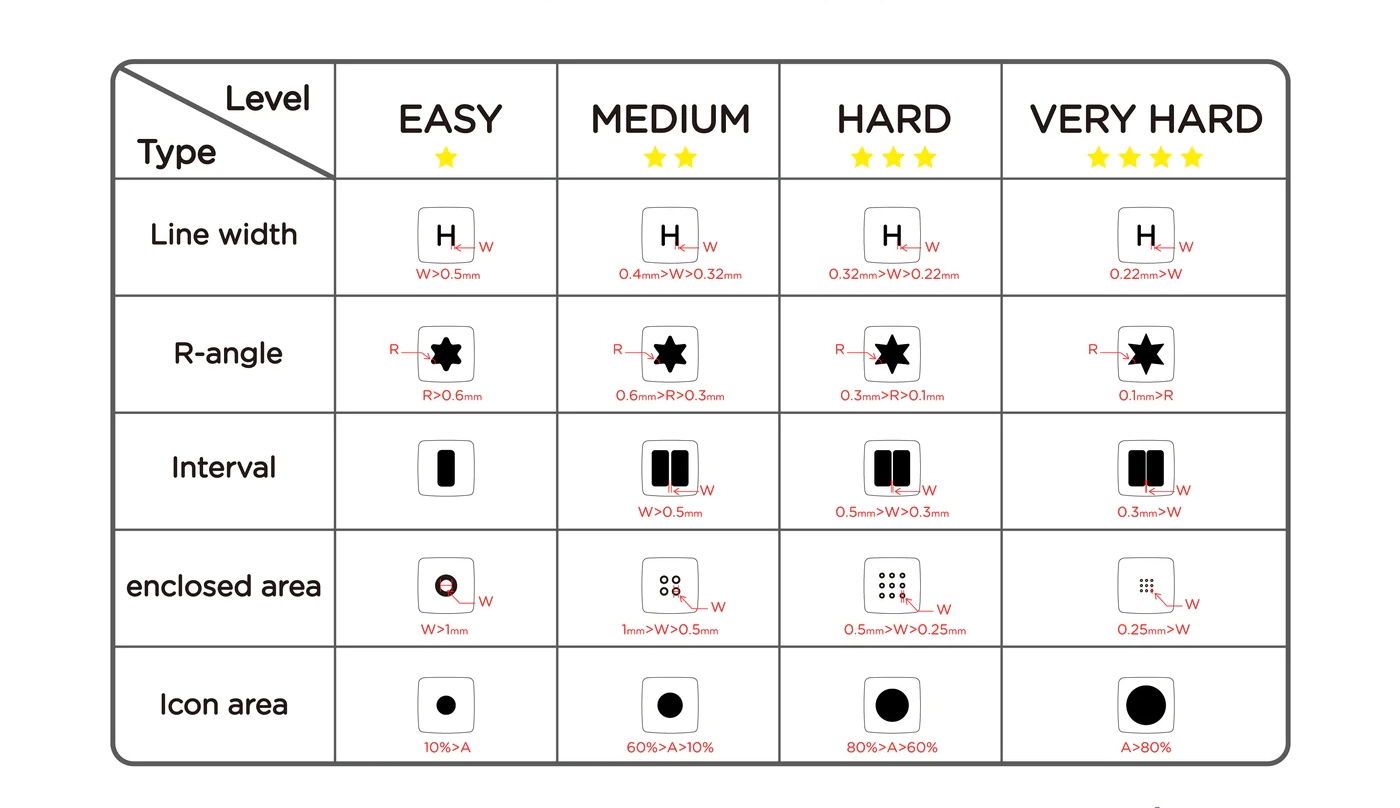
In our experience, manufacturability is influenced by line width, corner radius, feature spacing, enclosed regions, and the percentage of the key surface occupied by the icon. The values below are practical indicators of molding difficulty that we apply during DFM review.
| Difficulty | Line Width | Corner Radius | Feature Spacing | Enclosed Area | Icon Area Ratio |
|---|---|---|---|---|---|
| Easy | >0.50 mm | >0.50 mm | >0.50 mm | >1.00 mm | <10% |
| Medium | 0.40–0.32 mm | 0.60–0.30 mm | 0.50–0.30 mm | 1.00–0.50 mm | 10%–60% |
| Hard | 0.32–0.22 mm | 0.30–0.20 mm | <0.30 mm | 0.50–0.25 mm | 60%–80% |
| Very Hard | <0.22 mm | <0.20 mm | <0.30 mm | <0.25 mm | >80% |
Line Width and Spacing
We recommend keeping legend lines and the spacing between adjacent features above 0.30 mm to support material flow and reduce short-shot risk.
Corners and Radii
We advise avoiding acute internal corners. Corner radii above 0.30 mm support smoother filling and reduce local stress concentration.
Edge Clearance
We recommend keeping legends and decorative elements away from the outer edge, where mold shut-off is more difficult and flash risk is higher.
Stem and Enclosed Legends
We review enclosed characters against the cross-shaped mounting stem to avoid tool interference and loss of structural integrity.
Wall Transitions
We address abrupt wall-thickness changes during DFM because they can affect filling, cooling, shrinkage, warpage, and internal stress.
Draft and Ejection
We evaluate draft together with texture, legend geometry, cavity orientation, and ejection direction to limit drag marks and release defects.
Custom Font Development
We develop custom fonts with individual tooling for each legend. A complete extended set may contain approximately 200 keys, so our team evaluates full-font customization against the product’s visual identity, annual volume, and tooling budget.
- We avoid excessive sharp points and acute corners.
- We keep enclosed lowercase features above our recommended 0.30 mm range.
- We confirm all regional letters and special characters for European layouts.
- We review the complete punctuation set before releasing tooling.
- We verify commercial font-licensing rights before production.
Color Development and Material Preparation
We develop most Pantone-based colors through controlled material matching. Color quantity directly affects development and production cost, making color rationalization an effective cost-control measure in our process.
- We measure colorant ratios to two decimal places.
- We mold initial color plaques and inspect color difference.
- We adjust the formulation and repeat plaque validation.
- We uniformly blend the approved colorant with the selected resin.
- We pelletize and control production batches for lot-to-lot consistency.
Multi-Cavity Mold Engineering Considerations
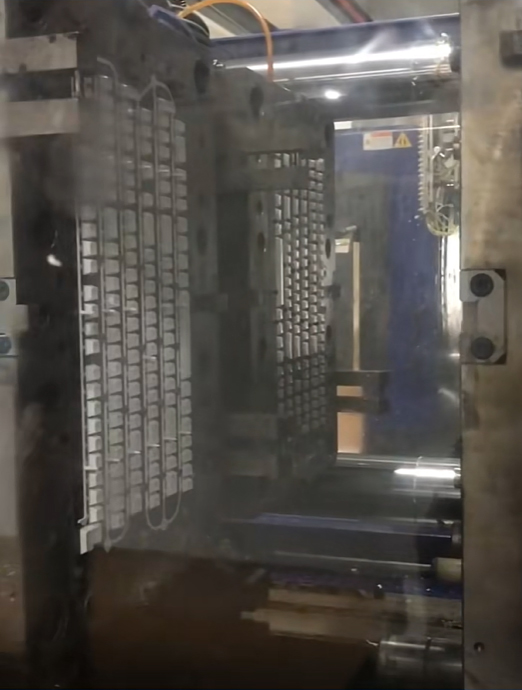
In our factory, a complete keycap mold must manage a high cavity count while maintaining consistent material flow, pressure, temperature, cooling, alignment, shut-off performance, and ejection throughout the tool.
Multi-Cavity Balance
We ensure every cavity receives comparable material flow, pressure, and thermal conditions to limit dimensional and cosmetic variation.
Cavity and Core Accuracy
We control the shell, legend, and mounting stem with precise first-shot and second-shot alignment to protect appearance and structural performance.
Gate Design
Our gate position and sizing support balanced filling while accounting for cosmetic surfaces, trimming, and narrow legend flow paths.
Venting
We include adequate venting for fine lines, enclosed areas, and end-of-fill locations to reduce trapped gas, burn marks, and incomplete filling.
Cooling Balance
Our consistent cooling limits differential shrinkage, warpage, dimensional variation, and cycle-to-cycle instability.
Shut-Off and Flash Control
Our accurate shut-off surfaces prevent color contamination, flash, and poorly defined boundaries between the two materials.
Ejection System
We balance ejection force and ejector placement to release all cavities without deforming the shell or damaging the stem.
Mold Flow Analysis
We use flow simulation to evaluate cavity balance, pressure distribution, air traps, weld lines, and short-shot risk before steel cutting.
From Mold Manufacturing to Injection Molding
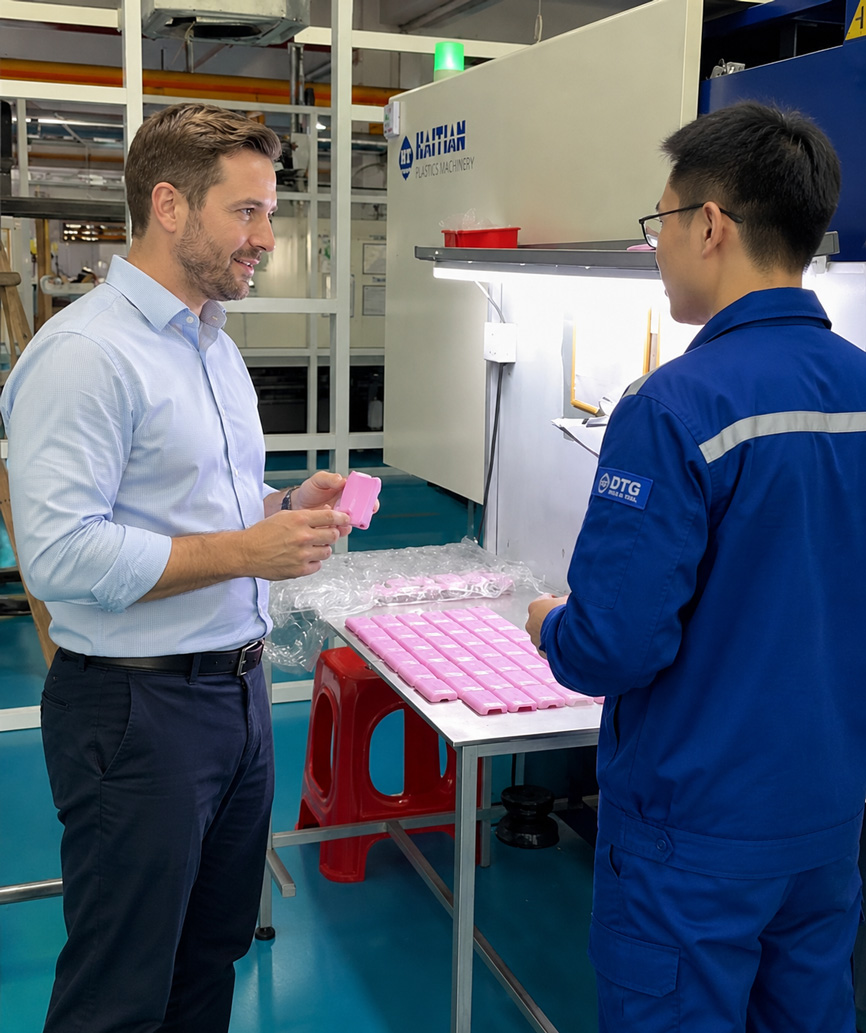
As a Custom Keyboard Keycaps Manufacturer, we coordinate DFM, precision toolmaking, material preparation, molding trials, process optimization, inspection, and production release within one project workflow.
Our Mold Manufacturing Operations
- We use CNC machining for mold plates, inserts, and cavity geometry
- We use slow-wire WEDM for precision profiles and narrow features
- We use EDM for detailed legends and complex internal structures
- We perform repeated precision grinding for alignment and shut-off accuracy
- We complete assembly verification and controlled mold trials
Our Production Sequence
- We assemble and verify the mold.
- We prepare the approved ABS or PBT resin.
- We mold the first material section.
- We index or transfer the first-shot component.
- We inject the second material.
- We cool and eject the integrated keycap.
- We inspect dimensional, structural, and cosmetic conformity.
Our Key Process-Control Parameters
Common Production Issues and Engineering Controls
In our experience, early DFM and process planning reduce the risk of defects that can affect an entire keycap set, production cycle, or shipment lot.
| Issue | Likely Cause | Our Recommended Control |
|---|---|---|
| Incomplete legend filling | Legend lines or enclosed areas are too narrow and restrict melt flow. | We increase feature width where possible, add suitable radii, and optimize molding conditions. |
| Short shots in fine features | Restricted flow path, poor gate balance, or insufficient venting. | We review gates, vents, temperature, pressure, flow balance, and feature geometry. |
| Flash near keycap edges | Legend or second-shot boundary is too close to the edge, or shut-off accuracy is insufficient. | We increase edge clearance and improve mold sealing and shut-off precision. |
| Inconsistent cavity quality | Uneven dimensions, temperature, pressure, filling, or cooling across the mold. | We improve cavity balance and maintain consistent thermal and processing conditions. |
| Surface shine after use | Long-term wear characteristic of ABS. | We recommend selecting PBT where resistance to polished surface appearance is required. |
| Poor enclosed-legend definition | Enclosed features are too small or the internal mold structure is overly complex. | We maintain recommended dimensions or use a sequential molding route for selected keys. |
| Cross-shaped stem damage | Enclosed-character tooling interferes with the internal stem structure. | We review legend-to-stem relationships during DFM and select an appropriate tool architecture. |
| Color inconsistency | Inaccurate colorant ratios, non-uniform blending, or uncontrolled production lots. | We control formulation, plaque approval, mixing, pelletizing, and batch verification. |
Our Quality Control for Complete Keycap Sets
In our quality assurance, we cover individual keycaps and set-level completeness. A local cavity deviation can affect the acceptance of an entire production cycle, so we emphasize preventive maintenance and process monitoring.
| Test Item | Our Inspection or Acceptance Requirement |
|---|---|
| Coordinate Measuring Machine Inspection | We perform full-dimensional precision measurement |
| Optical Measurement | We check planar dimensions and positional accuracy |
| Melt Test | We verify material-flow and melt-condition |
| Impact Test | We verify structural strength |
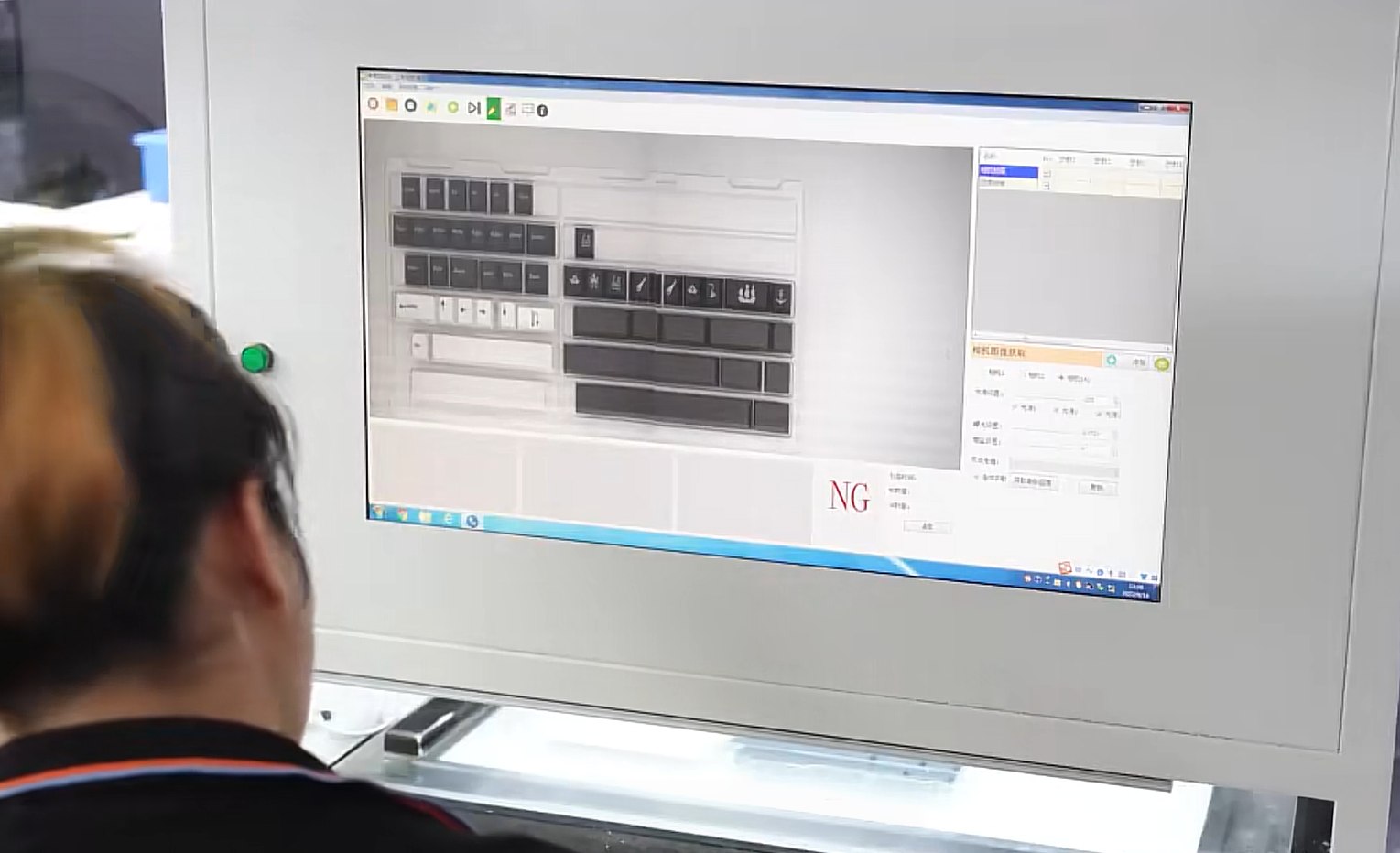
| AOI Legend Inspection | We perform automated inspection of legend completeness and definition |
| UV Test | We verify weathering resistance |
| Wear Test | After 100 rubbing cycles under a 500 g load, our keycap should not develop a polished appearance. |
| Environmental Compliance | We meet RoHS, REACH, and other applicable requirements |
Typical Lead Time and Production Capacity
Actual schedules in our factory depend on layout size, legend complexity, material, mold architecture, validation requirements, and the number of custom keys.
Approx. 35 Days
Our typical standard keycap mold development
Approx. 25 Days
Our typical small keycap mold development
Tens of Thousands
Our potential daily output, depending on cavity count and complexity
Our capacity planning for large keyboard programs
For projects with a particularly high number of keycaps, we may run two double-shot molds in parallel. Our capacity planning considers cavity count, molding cycle, expected yield, preventive maintenance, color-change frequency, inspection time, and complete-set packing.
We evaluate these factors during quotation and DFM to establish a practical tooling and production plan rather than relying on nominal machine output alone.
Our Integrated Mold Making and Injection Molding Support
We specialize in custom mold making and injection molding. We provide coordinated support from design evaluation and mold development to trial production, process adjustment, inspection, and mass production.
DFM and Design Evaluation
We review legends, wall sections, draft, stem geometry, material shrinkage, and tool feasibility before mold release.
Precision Mold Manufacturing
We manufacture high-cavity-count tools using CNC, WEDM, EDM, grinding, assembly, and controlled mold trials.
Flexible Molding Routes
We select one-cycle, sequential, or hybrid production according to volume, tooling economics, and legend complexity.
Production Communication
We provide project updates through mold processing, trials, sample review, modification, approval, and delivery.
Our project workflow
We follow: quotation and technical discussion → service agreement → advance payment → design evaluation → mold processing with progress reporting → mold trials and sample submission → modifications based on feedback → sample approval and balance payment → delivery through the agreed shipping method.
What We Demonstrate as a Two-Shot Keycap Supplier
As a professional two-shot keycap supplier, we demonstrate control over the entire manufacturing chain, not only access to a double-shot molding machine.
- Our DFM capability for fine legends, enclosed characters, and stem structures
- Our understanding of ABS and PBT shrinkage and flow behavior
- Our high-cavity mold design and precision manufacturing capability
- Our controlled color formulation and batch preparation
- Our inspection methods for legends, dimensions, stems, wear, and compliance
- Our set-level quality control and practical production-capacity planning
Our engineering focus for Custom Injection Molded Keyboard Keycaps
In our factory, successful mass production depends on coordinated product design, material selection, multi-cavity mold engineering, precision machining, color development, molding-window control, systematic inspection, and preventive tool maintenance.
Our objective is not simply to mold individual parts, but to repeatedly deliver complete keycap sets with consistent dimensions, appearance, mounting performance, and legend quality.
Engineering and Sourcing Questions
Can the same mold run both ABS and PBT?
We recommend confirming the material requirement before mold development. A mold we design around PBT shrinkage can generally also accommodate ABS, but an ABS-only mold normally cannot be transferred directly to PBT because of shrinkage differences.
Which process is better for custom novelty keys?
In our experience, sequential two-step molding generally provides greater flexibility for selected novelty keys, custom legends, multiple colors, and difficult enclosed characters. One-cycle molding is normally more economical for stable, high-volume standard layouts.
Why are enclosed legends difficult to mold?
Enclosed characters require additional internal mold structures while preserving the cross-shaped stem. Small enclosed areas also create narrow flow paths that increase filling, venting, shut-off, and machining difficulty.
What information is needed for a quotation?
For us to provide a quotation, useful inputs include 2D drawings, 3D data, keyboard layout, key quantity, legend files, material preference, color references, texture requirements, expected annual volume, compliance requirements, and target production schedule.
Request a Double-Shot Keycap DFM and Tooling Review
Send your key layout, legend artwork, material preference, color references, volume forecast, and target schedule. We will review process selection, legend manufacturability, mold architecture, expected lead time, and quality-control requirements.
Ready To Start Your Project?
Tell us about your part, material, quantity, or mold requirements. Our team will review your project and provide a practical manufacturing solution.