Handheld Scanner Housing Insert Injection Molding Solution for OEM Devices
Why Choose This Insert Molded Scanner Housing Solution
For handheld electronics, buyers care less about generic “quality” claims and more about sealing reliability, structural integrity, stable assembly, user comfort, and repeatable volume production. Our insert injection molding services are designed around those real project concerns.
Lower Assembly Cost
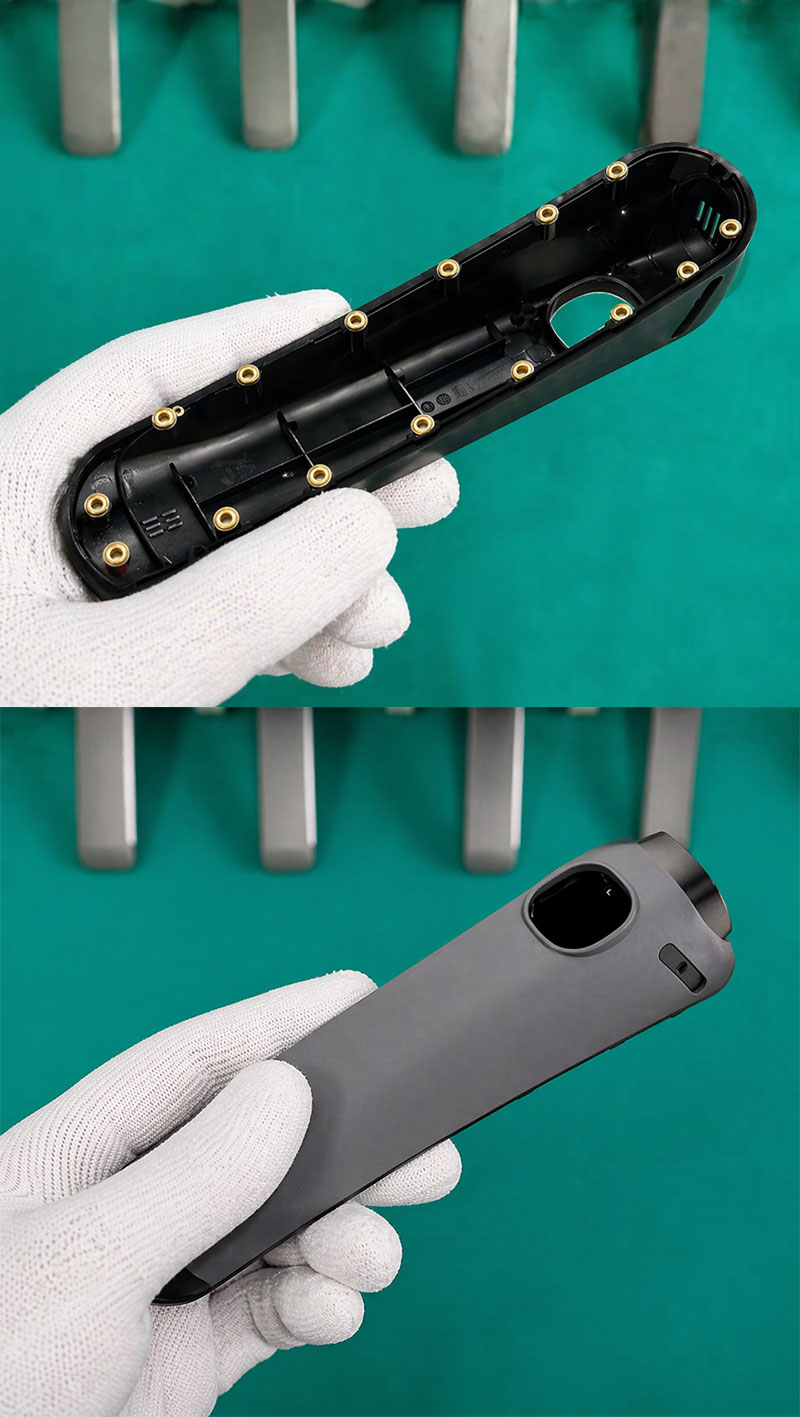
Metal inserts can be molded directly into the housing, reducing heat staking, riveting, and manual post-assembly operations.
More Reliable Fastening
Insert-supported screw locations improve thread durability and help prevent cracking or loosening in repeated use.
Better Grip & User Experience
Optional TPE or TPU overmolding creates a non-slip hand area for long operating cycles in industrial and retail environments.
Improved Sealing Strategy
Integrated geometry and overmolded functional areas can support more stable sealing performance than multi-part assembly structures.
Typical Applications and Industries
This enclosure structure is suitable for handheld products that need robust fastening points, a premium grip feel, repeatable dimensional accuracy, and controlled assembly quality.
Recommended Materials and Engineering Logic
For device housings, material selection is not only about resin type. The real engineering value comes from the balance of stiffness, impact resistance, bonding compatibility, shrinkage control, sealing design, and cosmetic performance.
Main Material Options
- ABS + TPE: Cost-effective, stable processing, good appearance, and common choice for grip overmolding.
- PC/ABS: Better impact resistance and dimensional stability for mid-to-high-end electronics housings.
- PC + TPU: Higher toughness and premium feel for demanding industrial or outdoor handheld devices.
- PA + TPE: Considered when strength and heat resistance are more critical.
- Flame-retardant PC/ABS: Used when projects require UL94 V0-oriented material options.
Insert and Secondary Material Strategy
- Brass inserts: Common for screw fastening points and repeated assembly locations.
- Stainless inserts or metal sleeves: Used when corrosion or higher strength is required.
- TPE / TPU soft zone: Adds grip, edge protection, and sealing support in functional areas.
- Engineering focus: Bonding compatibility, insert retention, thermal expansion balance, and moldability must be validated before tooling release.
Manufacturing Process Combination
Complex handheld housings are rarely solved by a single step. In most projects, the best result comes from combining mold engineering, insert molding, controlled injection parameters, and supporting CNC work for fixtures or prototype revisions.
DFM Review
Wall thickness, insert area, sealing geometry, undercuts, ejector strategy, and cosmetic risk review.
Mold Design
Tooling layout, insert positioning, gate balance, parting line control, and cooling design.
CNC Support
CNC machining for tooling details, fixtures, trial modifications, and prototype-assisted validation.
Insert Injection Molding
Automated or fixture-assisted insert placement followed by controlled molding for retention and accuracy.
Validation & Production
Trial samples, fit check, sealing review, assembly verification, and stable repeat production.
Insert / Overmolding vs Traditional Multi-Part Assembly
Many handheld device projects move from traditional assembly logic to integrated molding logic because it improves consistency, reduces parts count, and lowers quality risk in mass production.
Common Mass Production Risks and How DTG Addresses Them
Buyers and engineers want to know whether a supplier can move beyond samples and actually manage production risk. Below are common issues in electronic enclosure programs and the corresponding process control logic.
Insert Misalignment
We use fixture-assisted or automated insert placement concepts, plus mold positioning design, to reduce offset risk and improve retention consistency.
Warpage and Sink Marks
Rib layout, wall-thickness balancing, gate location optimization, and cooling design help control deformation in long, slender housing parts.
Flash and Cosmetic Defects
Precision tooling, proper parting line strategy, and stable process windows support a cleaner cosmetic result for visible exterior surfaces.
Grip Zone Delamination
When overmolding is required, we review material compatibility, bonding behavior, temperature window, and interface design before mass production.
Sealing Failure
Functional sealing depends on structure design, compression logic, tolerance control, and process stability rather than a single material choice.
Assembly Variation
Integrated molding reduces tolerance stack-up across separate components and helps stabilize downstream assembly efficiency and yield.
Validation and Compliance Support
Depending on your project, we can align materials and structure review with downstream verification needs such as IP-oriented sealing development, flame-retardant material selection, impact-oriented design validation, and RoHS / REACH material compliance support.
What We Can Support
- DFM review for sealing-sensitive and insert-heavy structures
- Mold flow-oriented discussion for filling, weld line, and air trap risk
- Insert retention and assembly area design optimization
- Material selection based on strength, appearance, and application environment
Project-Oriented Targets
- IP67 / IP68 development cooperation for suitable enclosure programs
- UL94 V0 material path discussion where required
- RoHS / REACH compliance support for export projects
- Drop resistance and long-use handling optimization for handheld devices
Frequently Asked Questions
1. Can you provide custom insert injection molding service based on our 3D file?
Yes. We can review your STEP or 3D design, provide DFM suggestions, evaluate insert locations, and recommend a suitable mold and production strategy.
2. What insert types can be used in this kind of housing?
Common options include brass threaded inserts, metal sleeves, and selected custom metal components depending on fastening, strength, and assembly requirements.
3. Can this enclosure include both insert molding and soft-touch overmolding?
Yes. For some projects, insert molding and soft-zone overmolding can be combined, provided the part structure, tooling plan, and material compatibility are validated early.
4. What do you need to quote an electronic housing project?
Please send your 2D/3D drawing, annual volume, resin preference, insert details, assembly requirements, surface finish expectations, and any sealing or validation targets.
5. Do you support tooling and mass production, not just samples?
Yes. We support mold design, mold making, sample trials, revision support, and repeat production for OEM enclosure programs.
Ready To Start Your Project?
Tell us about your part, material, quantity, or mold requirements. Our team will review your project and provide a practical manufacturing solution.