Automotive Electronic Water Pump Housing Insert Molding | DTG
Custom Insert Injection Molding Service for Automotive Electronic Water Pump Housing
In engine cooling circuits, new energy vehicle thermal management systems, and hybrid auxiliary circulation loops, the real concern is not whether the housing can be molded, but whether a custom insert injection molding service can ensure sealing reliability, terminal stability, dimensional consistency, and long-term durability under coolant exposure, thermal cycling, vibration, and repeated connector use. Professional insert injection molding services are expected to reduce leakage risk, prevent connector mismatch, shorten assembly time, and support a better balance between cost and service life.
- Residual heat management after engine shutdown and turbocharger cooling
- Battery pack, e-drive, power electronics, and cabin thermal management circulation
- Localized low-flow circulation loops in hybrid vehicle systems
- Leakage at terminal roots, sealing surfaces, or functional circular interfaces
- Dimensional drift after heat exposure, moisture absorption, or coolant aging
- Poor connector mating caused by terminal shift or shroud deformation
- Batch inconsistency affecting takt time, yield, and long-term field reliability
How the Product Structure Addresses Engineering Challenges
This housing combines engineering resin, metal insert molding, and an integrated electrical connection structure. A strong custom insert injection molding service must manage sealing paths, insert retention, connector geometry, load transfer, and assembly efficiency at the same time rather than treating the housing as a simple cosmetic cover.
Metal Insert Terminal System
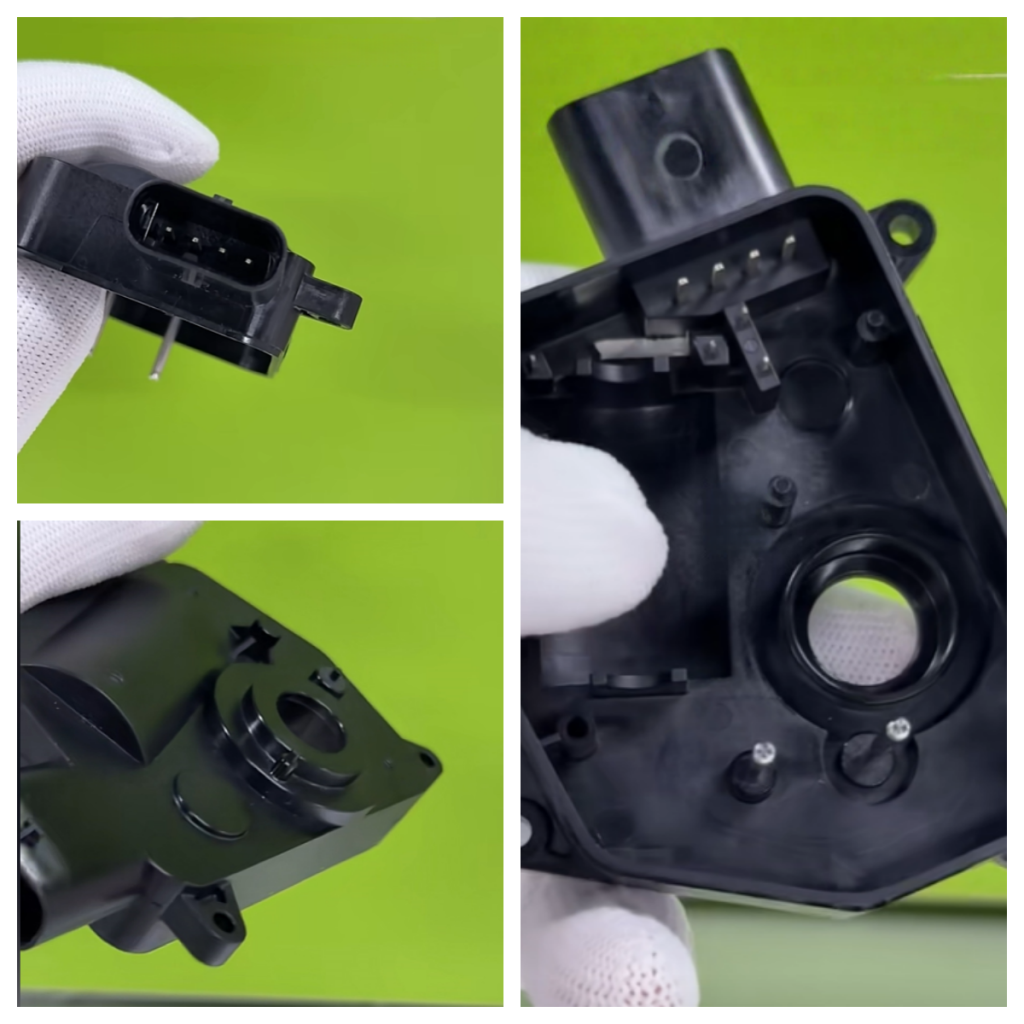
External connector terminals and internal conductive tabs are directly overmolded by plastic. This reduces loose-part assembly, improves waterproofing control, and increases vibration resistance, provided the insert location is controlled precisely in the mold.
Integrated Structural Housing
The multiple mounting ears and screw locations indicate a structural part that must fasten to the pump body or bracket, provide assembly pre-location, and transfer service vibration loads without cracking or excessive warpage.
Critical Circular Functional Area
The circular feature may act as a sealing interface, pass-through location, or O-ring seat. In all cases it is a critical tolerance zone that influences flatness, concentricity, sealing compression, and assembly resistance.
Functional Internal Features
Bosses, steps, barriers, and retention paths may support PCB mounting, sensor location, sealing control, and assembly poka-yoke. This makes the component a functionally integrated structural housing rather than a standard molded shell.
Common Production Issues & Solutions
| Common Production Issue | Possible Cause | Recommended Solution |
|---|---|---|
| Terminal position shifts, causing connector mating failure or poor contact | Unstable insert positioning, melt-flow displacement in the mold, or inadequate fixture precision | Use anti-rotation and anti-shift insert positioning features, optimize gate direction, and add in-line vision inspection |
| Leakage at terminal roots or sealing failure | Insufficient overmolding, contaminated insert surfaces, or cracking caused by thin sections | Add mechanical locking features, clean or pre-treat inserts, increase overmold thickness, and optimize transition radii |
| Warpage of the housing sealing surface after assembly | Uneven wall thickness, glass-fiber orientation, uneven cooling, or screw-load deformation | Run mold flow and warpage analysis early, optimize cooling and gate layout, and equalize wall thickness around sealing areas |
| Screw boss cracking or whitening after fastening | Small boss diameter, insufficient reinforcement, brittle material, or excessive tightening torque | Optimize boss diameter and root radii, add ribs, redefine torque windows, and consider threaded inserts where necessary |
| Flash or deformation in the connector shroud cavity | Poor parting-line control, low venting efficiency, or local weld line and shrinkage influence | Keep critical mating surfaces away from risky parting areas, optimize venting, and strengthen critical-dimension inspection |
| Surface sink marks, depressions, or internal voids | Excess local mass, low packing pressure, or improper gate location | Replace thick sections with ribs, optimize packing pressure, and rebalance local section thickness ratios |
| Insufficient terminal pull-out force after vibration exposure | No interlock structure on the insert, inadequate plastic retention, or poor toughness | Add holes, steps, barbs, or knurled features and verify pull-out retention after thermal cycling rather than only at initial inspection |
Key Features of Our Services
- Precision insert positioning for integrated terminal and connector structures
- Support for sealing-critical housings with complex bosses, ribs, and functional interfaces
- Rapid prototyping and process-oriented DFM review before tooling release
- Stable insert injection molding services for pilot runs and volume production
- Material selection support for PA66 GF30/35, PPA, PPS, terminal plating, and sealing systems
- Inspection and validation planning for pull-out force, dimensional stability, waterproofing, and production consistency
Product Structural Design Guidelines
Wall Thickness Design
Uniform wall thickness should take priority over excessive section buildup. Typical main wall thickness is 2.0-3.0 mm, while PPS structures may use 1.5-2.5 mm depending on design and load requirements.
Rib, Draft, and Radius Design
Rib thickness is commonly 0.5T-0.7T, rib height is generally below 2.5T-3T, outer draft is often 0.5°-1.5°, and internal radii should generally not be smaller than 0.3-0.5 mm.
Bosses and Sealing Features
Boss outer diameter is typically around 2.0-2.5 times the nominal screw diameter. Static seal compression is often recommended at 15%-25%, and flatness of sealing surfaces should be treated as a critical characteristic.
Critical Tolerance Chain
Priority dimensions normally include terminal position, connector shroud geometry, sealing-surface flatness, circular functional area true position, and mounting-hole location rather than trying to control every dimension equally.
Material Solution Analysis
Recommended Material Combination
- Housing: PA66 GF30 or PA66 GF35
- Metal terminals: Brass or copper alloy
- Terminal finish: Tin plating or nickel undercoat plus tin plating
- Sealing material: EPDM for standard coolant systems or FKM for higher-temperature environments
Selection Notes
- PA66 offers good strength, stiffness, and heat resistance for many auxiliary pump programs
- Glass fiber improves dimensional stability but requires careful warpage control
- PPA or PPS should be evaluated first for high-temperature or long-life engine compartment applications
- Low-moisture-absorption systems are preferred where connector dimensional precision is highly critical
Manufacturing Process & Validation Capability
The core process is metal insert molding. Successful execution depends on automated insert feeding or precision fixture positioning, poka-yoke against reverse loading or missed inserts, displacement control during injection, and in-line terminal position inspection after molding. This is where advanced insert injection molding services create clear value in quality assurance and stable delivery.
DFM Optimization
Before tooling starts, the design should be reviewed for insert clamping space, draft direction, sealing-surface warpage, and sink-mark risk around bosses and ribs.
Mold Flow Analysis
Analysis should assess weld-line placement, overmolding around terminal roots, fiber orientation effects, cooling balance, and connector region distortion risk.
Verification & Process Control
Recommended checks include pull-out force, thermal cycling stability, media immersion performance, waterproof validation, and SPC/Cpk monitoring for critical dimensions.
Related Internal Links
Industry Certification & Program Requirements
Ingress Protection
IP67 is common, and some projects may require IP6K9K depending on splash water, spray, and humid exposure conditions.
Environmental Reliability
Programs typically evaluate high/low temperature cycling, thermal shock, humidity, vibration, salt spray, and coolant compatibility.
Material Compliance
RoHS, REACH, and IMDS are common expectations, with additional customer-specific restricted substance declarations in some projects.
Automotive Project System
APQP, PPAP, IATF 16949, Control Plan, PFMEA, MSA, and SPC are often more important than stand-alone promotional certifications.
DTG TECH CO., LTD. – Your Trusted Partner in Mold Manufacturing & Injection Molding
DTG TECH CO., LTD. specializes in custom mold making and injection molding. We provide comprehensive services from mold design to mass production, ensuring quality and efficiency. For buyers looking for a reliable custom insert injection molding service, our team supports product analysis, prototyping, tooling, process validation, and flexible manufacturing for both low- and high-volume programs.
One-Stop Mold And Injection Molding Solutions
- Mold design and creation refined for production requirements
- Prototype manufacturing for product validation
- Product analysis to improve performance and cost-effectiveness
- Flexible manufacturing without sacrificing quality
Our Process
- Quote & Discussion
- S/C Signature
- 50% Advance Payment
- Design Evaluation
- Mold Processing
- Mold Testing
- Mold Modification
- Balance Payment
- Delivery
Why Choose Us
- ISO-based quality management
- Experience in electronic component injection molding
- Advanced molding equipment for repeatable precision
- Fast delivery with efficient project management
- Customer-focused communication and long-term cooperation
Project Summary
The main challenge in this project is not basic molding alone, but the simultaneous achievement of metal insert integration, electrical connection performance, waterproof sealing, assembly compatibility, and dimensional stability. This component is a functionally integrated housing that must perform reliably throughout development, validation, and mass production.
Key priorities should include operating temperature range, contact media, target IP rating, terminal interface standard, critical sealing interfaces, tolerance chain, and material system. When these points are addressed early, a qualified custom insert injection molding service can support lower risk, better cost control, and more stable delivery for automotive programs.
Ready To Start Your Project?
Tell us about your part, material, quantity, or mold requirements. Our team will review your project and provide a practical manufacturing solution.